Paraphrasing vs Summarizing: What’s the Difference?
Apr 20, 2026
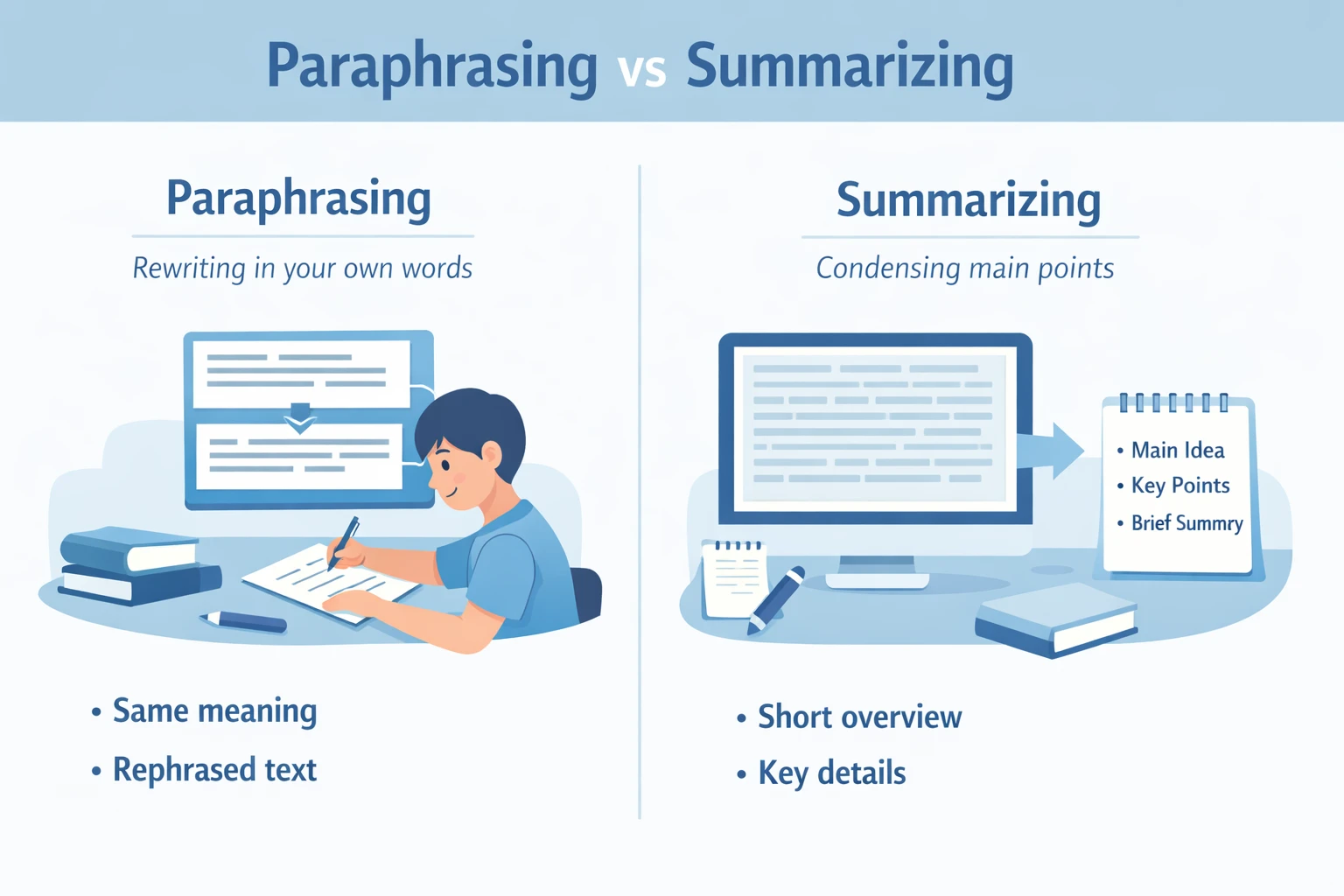
Paraphrasing vs summarizing is the difference between rewriting content in different words while keeping the same meaning and shortening content by focusing only on the main ideas. Paraphrasing keeps full detail, while summarizing reduces it into a shorter version.
Several students, bloggers and content writers tend to mix up paraphrasing and summarizing. Both appear to be similar at first since they both require you to rewrite information in your own words. But in practice, they have different purposes in writing, SEO content creation, and academic work.
Problems that occur because of this confusion include misunderstandings in assignments, poor writing structure and even plagiarism problems. The distinction is relevant in content writing and SEO to create original and high-quality work.
Simply put, paraphrasing is all about rewriting what has been written using different words, although the meaning remains the same, whereas summarizing is all about reducing what has been said to a brief version of the main idea. Both are important writing skills that apply in different contexts, depending on your objective.
In this guide, you will learn:
• The clear difference between paraphrasing and summarizing
• Real-life examples of both techniques
• When to use each method in writing
• A simple decision system to choose correctly every time
• How both techniques affect plagiarism-free writing and SEO
By the end of this article, you will have a clear understanding of paraphrasing vs summarizing and will never get them confused again.
What Is Paraphrasing?
Paraphrasing literally means rephrasing something using your own words and at the same time retaining the original meaning of the word. This implies that you are saying the same thing with different words without making it very short or distorting its main idea.
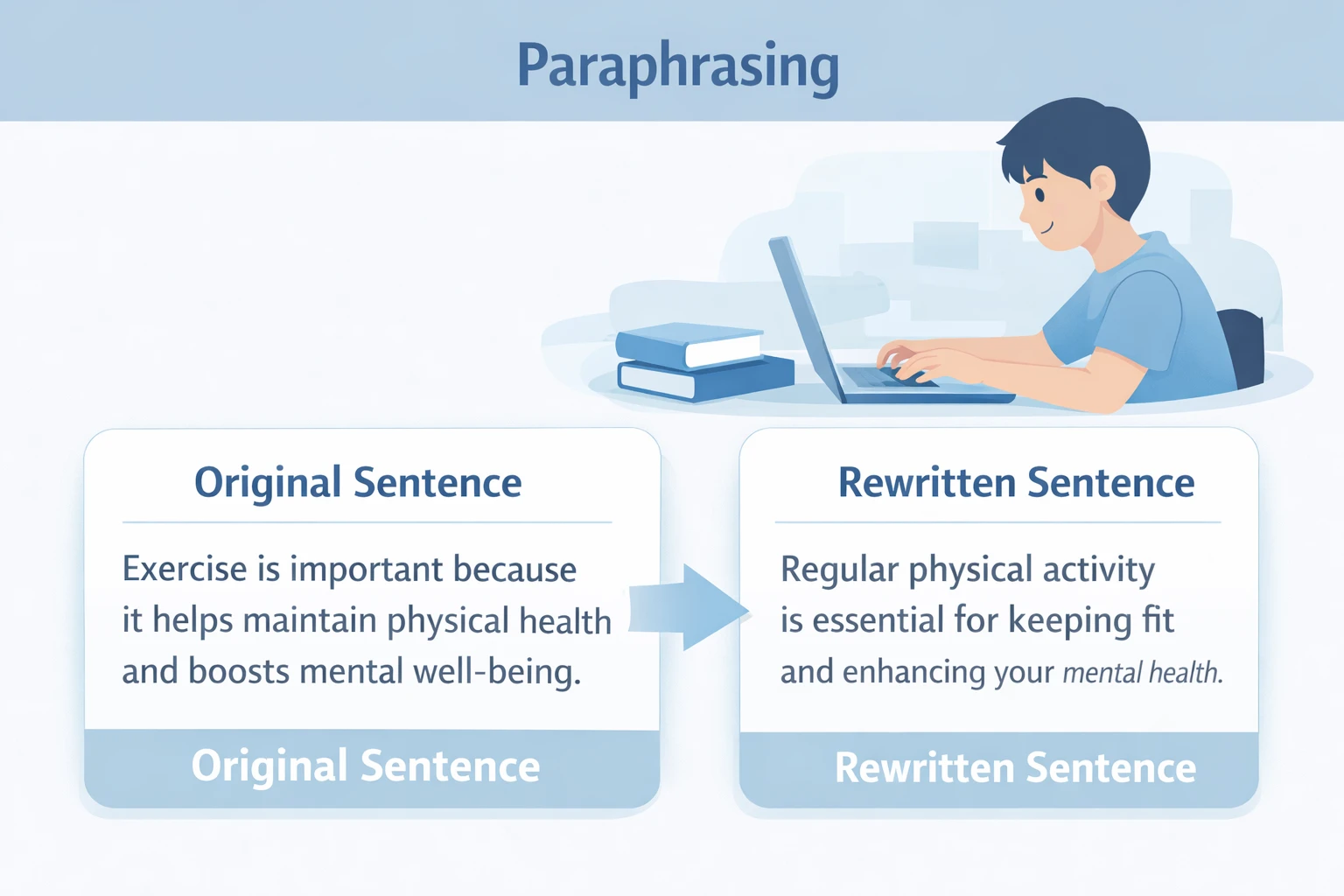
Paraphrasing is embraced frequently in academic writing as well as blog writing, as it preserves originality and enhances readability. The writers do not repeat the sentence in a word-to-word context; they apply various structures and other words and sentence structures to generate originality.
For example, if a sentence says the following:
Water pollution is harmful to marine life.
It may be rephrased as:
Marine animals are negatively affected by polluted water environments.
The meaning is the same, but the wording and organization are different.
Phrasing is particularly helpful in:
• SEO blog writing
• Academic assignments
• Research papers
• Content rewriting for websites
It also has a significant role in preventing duplication problems and enhancing plagiarism-free writing. Grammarly, e4tools or QuillBot is used to aid paraphrasing, but human intuition would always be more significant.
In simple terms, Paraphrasing refers to a rewriting of ideas in an easy and comprehensible way without changing the meaning of the ideas and is a very important skill when it comes to creating content and as a student.
What Is Summarizing?
The summary can be defined as the process of reducing the size of text and retaining the most significant concepts. Summarizing is not paraphrasing which does not alter the original size of the text; rather, its aim is to minimize the text into a small form that can easily be understood.
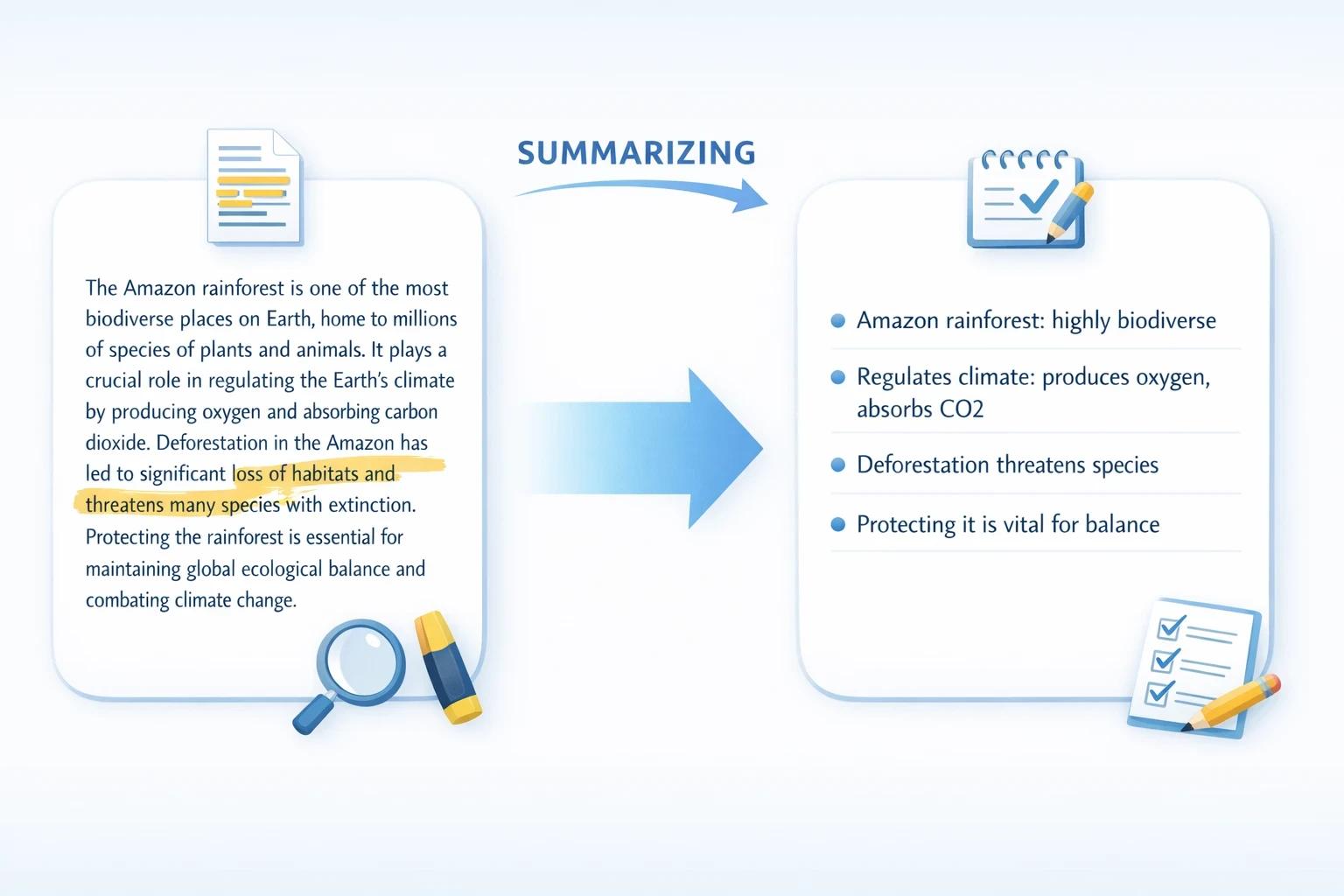
The primary purpose of summarizing is to derive key points and eliminate unnecessary details. This method is very popular for taking notes, preparing examinations, and sharing information very fast.
To illustrate, a paragraph that describes a complete story using 100 words would be summarized using 20-30 words using only the keynote.
Summarizing is extremely helpful in:
• Academic revision notes
• Business reports
• News articles
• Quick content understanding
Summarizing is also a content writing aspect that enhances the clarity and readability of any writing, especially with big content. It assists the readers in understanding the key points without reading the entire text.
In comparison to paraphrasing, summarizing alters the content in length and the level of detail. It is not concerned with rewriting all the sentences but with the way of capturing the brief version of the original meaning.
In simple terms:
• Paraphrasing = Same meaning, different words
• Summarizing = Same meaning, fewer words
The two methods are most critical in SEO writing of content, particularly enhancing user experience and readability of the content.
Key Differences Between Paraphrasing and Summarizing
The distinction of paraphrasing and summarizing is quite essential for writers, students, and SEO professionals.
Both are about rewriting, but there is a great difference in the purpose and result. The content in a paraphrase is rewritten in detail, whereas in summarization the content is reduced to the main idea.
Main Differences:
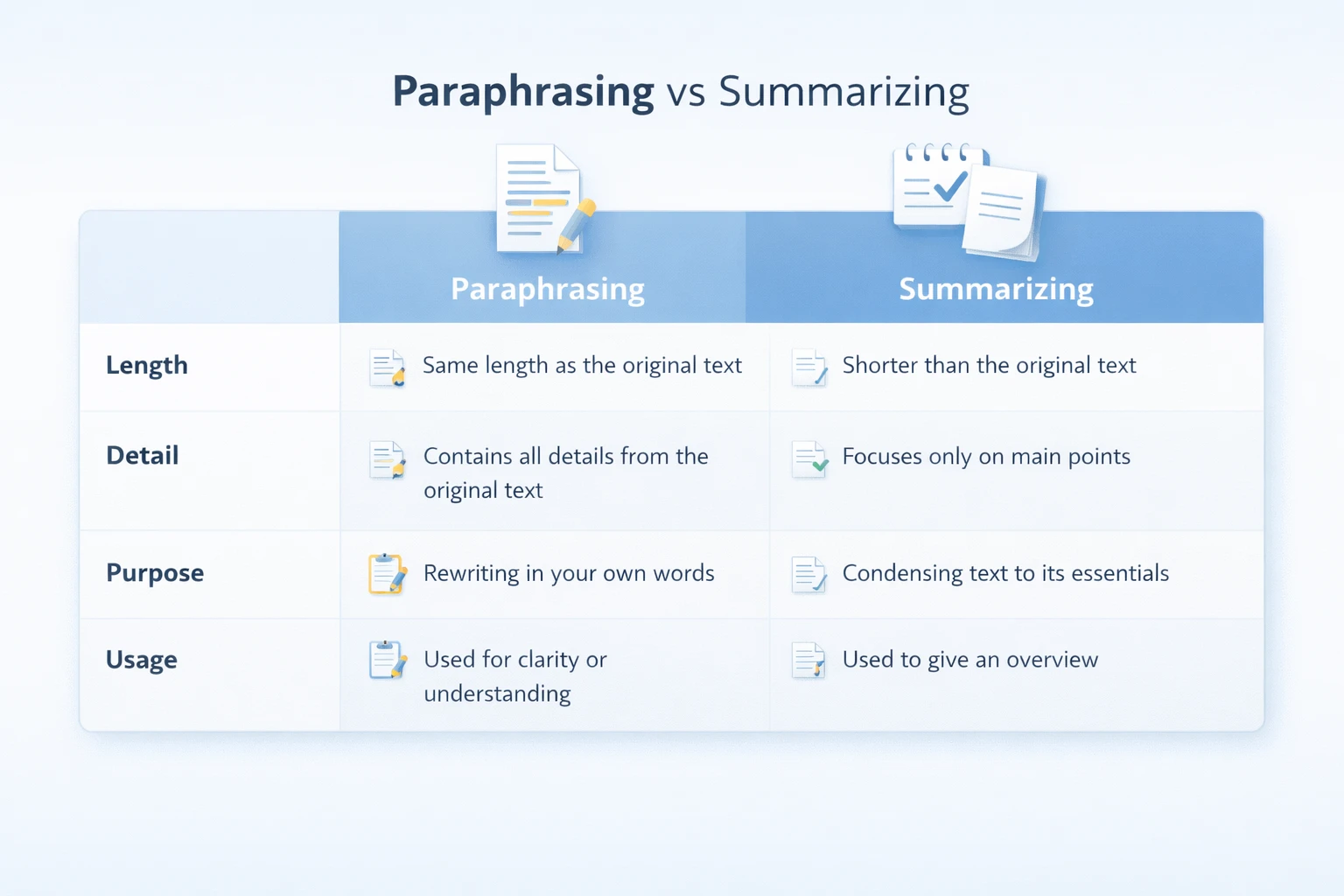
Simply put, paraphrasing is used when you wish to express a given thing differently without altering its size, whereas summarizing is done when you wish to condense large amounts of information into a small size.
For example, paraphrasing in SEO content writing is intended to enhance originality and prevent duplication, whereas summarizing is intended to enhance readability and generate brief explanations.
It is also significant in academic writing, in which wrong usage can impact grades or result in plagiarism.
This difference could be better understood to enhance the quality of writing and the effectiveness of the content.
Real Examples of Paraphrasing and Summarizing
Let’s understand the difference between paraphrasing and summarizing using real text.
Original Text:
Digital marketing is an effective approach that businesses use to attract the attention of customers via online marketing platforms like social media, search engines, and websites to enable companies to expand their audience and sales.
Paraphrased Version:
Digital marketing is the appropriate tool which enables companies to reach consumers through online systems such as search engines, websites and social media. It facilitates business expansion and contributes to improved sales.
Summarized Version:
Digital marketing enables companies to expand by accessing consumers over the internet.
These instances clearly show how the paraphrasing can retain the detail, but the summarizing can reduce the content to the main points.
When to Use Paraphrasing vs. Summarizing
Whether to paraphrase or summarize depends on what you need to write.
Use paraphrasing when:
• You want to explain ideas in detail.
• You are writing blogs or SEO content
• You need to maintain full meaning
• You want original content writing
Use summarizing when:
• You want quick understanding
• You are making notes.
• You need short explanations
• You want to reduce long content
Paraphrasing is more frequently observed in SEO content writing, since it contributes to the preservation of originality and the enhancement of ranking on search engine performance. In summary, conversely, summarizing instead is valuable in enhancing user experience and readability.
Knowledge of when to apply each technique enhances the quality of your writing, and thus, better expression of ideas.
🧠 Simple 3C Framework for Better Writing Decisions
To make the decision even easier, use this simple framework:
C → Compare the purpose
Understand the difference:
Paraphrasing = detailed rewriting
Summarizing = short version of main idea
C → Choose your goal
Ask yourself:
Do I need full detail or just key points?
C → Convert correctly
Apply the method:
Rewrite fully (paraphrasing) or shorten (summarizing)
👉 This framework helps you quickly decide the right technique without confusion.
Common Confusion Between Paraphrasing and Summarizing
The distinction between paraphrasing and summarizing remains confusing to many learners despite the explanations.
The easiest thing to eliminate confusion is to keep this in mind:
👉 Phrasing is not cutting content short instead it is rephrasing it with equal amounts of detail.
👉 A summary is not a simple rewrite but a narrowing down to the key points.
In other simple language:
• If someone reads your content and gets a full explanation → it is paraphrasing
• If someone reads your content and gets only key points → it is summarizing
In real writing situations, both techniques are often used together. Writers strongly paraphrase before summarizing and then use ideas where necessary as notes or blogs or SEO materials.
This is the reason why knowing intent (not words) is the key to making the right choice.
How to Choose Between Paraphrasing and Summarizing
In order to simplify it, here is a simple decision system. The basis of selecting the appropriate technique lies in your purpose, type of content and the level of detail required.
Step 1:
Do you need a full explanation?
• Yes → Use paraphrasing
Step 2:
Do you only need key points?
• Yes → Use summarizing
Step 3:
Is it for SEO or blog writing?
• Yes → Paraphrasing is better
Step 4:
Do you want shorter content?
• Yes → Summarizing
Simple Rule:
• Same meaning, same length → Paraphrasing
• Same meaning, shorter version → Summarizing
Quick Memory Rule:
• Same meaning, same length → Paraphrasing
• Same meaning, shorter version → Summarizing
This system of decision-making is useful in preventing confusion and ensuring proper use in any form of writing.
PARAPHRASING VS SUMMARIZING IN SEO WRITING
Paraphrasing and summarizing are significant in SEO content writing. These methods have direct impacts on content originality, ranking potential, and user engagement cues.

Paraphrasing could be used to develop plagiarism-free writing by paraphrasing the content in a different manner. This enhances originality and gives websites better ranking in search engines.
Summarizing aids in enhancing readability by reducing long content to concise, digestible points. This enhances user experience and minimizes bouncing rate.
Google and other search engines favor originality in the content, usefulness, and understandability, which makes both techniques useful in the strategy of SEO content strategy.
Many applications such as Grammarly and QuillBot may assist, yet the skill of human writing is crucial. However, poor-quality content can be achieved by over-depending on tools without knowing their meaning.
COMMON MISTAKES
Even experienced writers make these mistakes, especially when rushing content creation.
• Only replacing words (bad paraphrasing)
• Losing original meaning
• Over-shortening content
• Copying structure
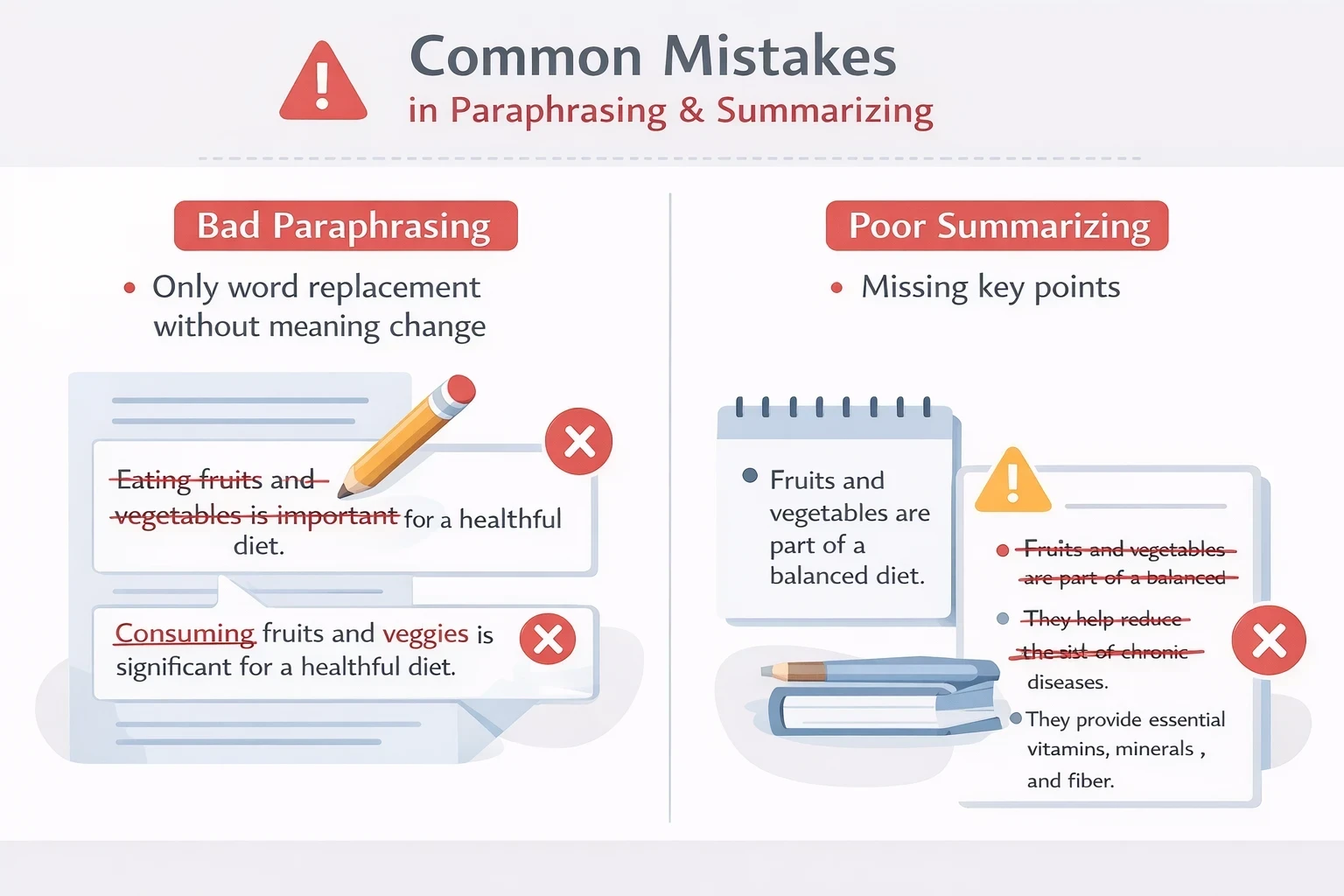
Such errors decrease the quality of the content itself and may result in the problem of plagiarism.
To prevent this, you always must pay special attention to get the meaning and then rewrite appropriately.
THE REAL RISK (WHY MANY WRITERS GET IT WRONG)
Lots of authors have no idea how to think about the paraphrasing vs. the summarizing, as they frequently pay attention to replacing words or reducing the content; however, they do not comprehend the sense.
This leads to:
• accidental plagiarism
• loss of original meaning
• weak content quality
• poor SEO performance
👉 It is not about writing words down again, but about comprehending the meaning and then transferring it properly.
FAQs
The main difference that exists between paraphrasing and summarizing is the detail that is retained. Paraphrasing can be defined as a restatement using your own words but at the same level of detail and meaning. Summarization on the other hand decreases the content size as it emphasizes the significant aspects.
• paraphrasing = rewriting in detail with the same meaning.
• Summarizing = concise point about main ideas.
No, none is superior, since both have different purposes. Detailed explanations, essays, and blog writing are paraphrased, and notes, revision, and fast comprehension of lengthy material are better done via summarization.
Yes, with the proper help of paraphrasing it could be prevented, but it must be done correctly. It involves the process of rephrasing the sentence structure and words without any change in meaning. To ensure that a piece of information has not been plagiarized, then it is not enough to just replace a few words.
Summarizing should be used when all you require are the main points of a long text. It is used commonly in making study notes, overviews of research and making long content a short, readable topic.
The importance of paraphrasing in SEO content writing is that it enables one to produce original and plagiarism-free work, which is easier to read and comprehend. It also enhances the uniqueness of the contents to aid search engines in ranking the pages.
The summarizing process involves 5 easily understandable steps: read, isolate the main points, filter out irrelevant information, paraphrase your words and simplify your summary into concise and clear. Such guidelines can help to generate useful and simplified summaries.
Paraphrasing is normally done, first, as you initially put the content in your own words while maintaining the same meaning. Subsequently, the rewritten content is summarized to reduce it to major points.
Conclusion
To conclude, paraphrasing and summarizing are both critical writing communication skills, yet the context of their usage varies depending on writing, SEO content development, and academic writing. The paraphrasing is concerned with the process that is aimed at rewriting the content while preserving the initial meaning; the summarizing is concerned with the reduction of the information to main points.
Knowledge of paraphrasing vs summarizing can assist you in enhancing strength of writing, clarity of the content, performance of SEO, and academic accuracy. It also assists you in deciding on the appropriate approach based on your writing objective.
Through the proper technique in the correct time, you will manage to produce more original, clear and effective material that will be easier to read and more useful to users and search engines.