How to Calculate Age Manually (Step-by-Step Guide with Examples)
May 13, 2026
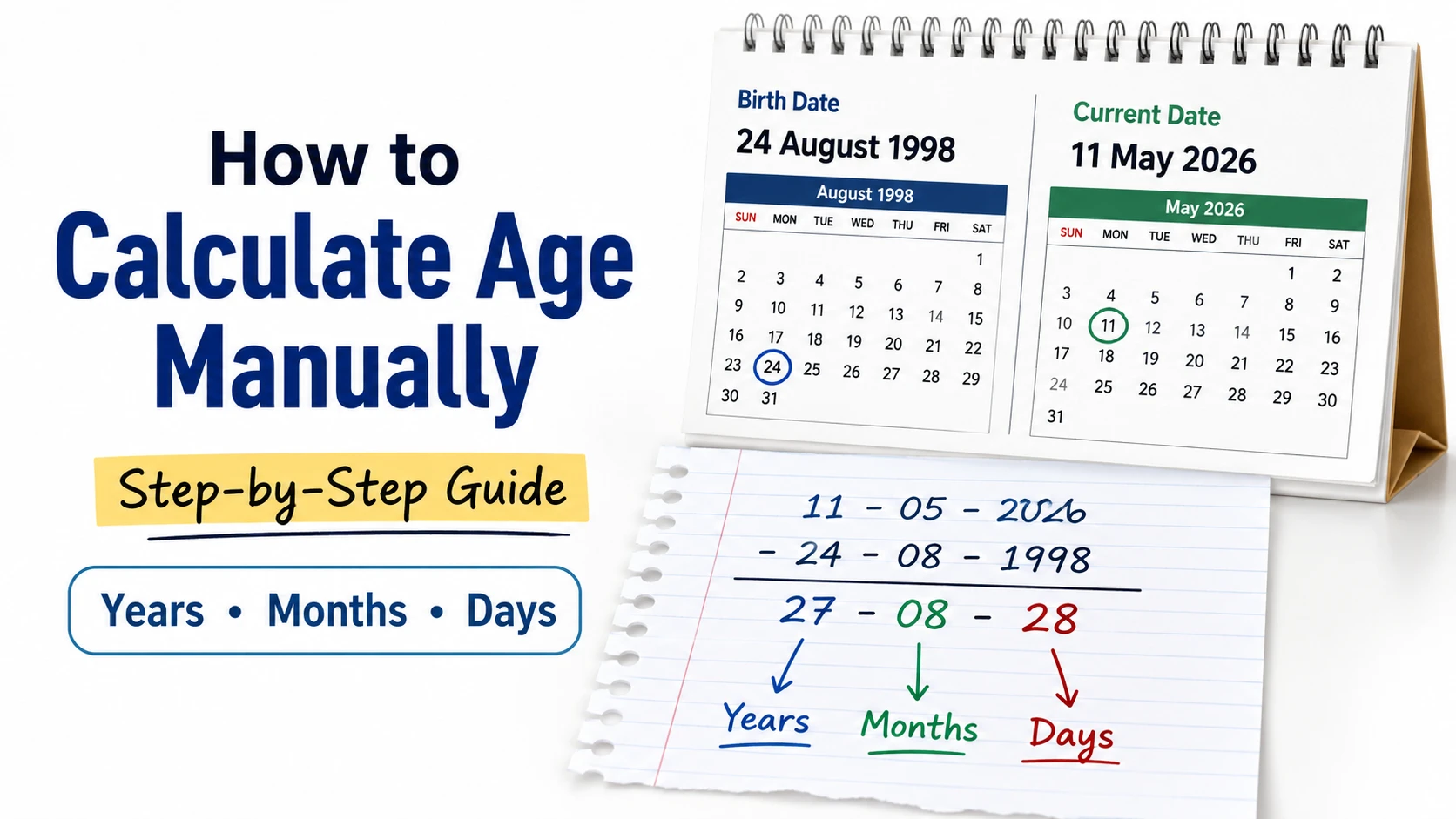
How to calculate age manually means finding a person’s exact age by subtracting the date of birth from the current date and then correctly adjusting years, months, and days using proper calendar logic instead of relying on a calculator or digital tool.
In real situations, the process looks simple, but it often becomes confusing because dates don’t work like normal numbers. Months have different lengths, leap years add extra days, and small mistakes in subtraction can entirely change the final result. That’s why many people struggle when calculating age manually, especially in school forms, job applications, or official documents where accuracy really matters.
Most people calculate age incorrectly — even in official documents — without realizing it.
I’ve noticed that many explanations online only show basic subtraction and ignore the logic behind borrowing months or days, which is where most calculation errors happen in real life.
There are also many practical situations where manual understanding becomes important. HR departments often verify records step by step, schools use strict age cut-off dates for admissions, and paper-based forms require quick calculations without digital tools or internet access.
In this guide, you’ll learn a clear step-by-step method to calculate age manually, along with real examples and simple date arithmetic. We’ll also break down how years, months, and days are adjusted properly, how borrowing works in subtraction, and why leap years can slightly affect the final result.
What Does “Manual Age Calculation” Mean?
Manual age calculation means determining a person’s age by subtracting the date of birth (DOB) from the current date or another reference date without relying on automatic software or calculators.
Before digital calculators became common, manual date arithmetic was regularly taught in schools and used in office records, forms, and administrative calculations.
In simple terms:
Current Date − Birth Date = Age
However, the process is not as easy as normal subtraction because calendar dates contain the following:
Different month lengths
Leap years
Uneven numbers of days
Month and year adjustments
A proper chronological age calculation usually includes:
Years
Months
Days
For example, if someone was born on:
24 August 1998
And today’s date is:
11 May 2026
Their age is not simply
2026 − 1998 = 28
Because their birthday in August has not arrived yet in 2026. The months and days must also be adjusted correctly.
This scenario is where date arithmetic becomes important and falls under calendar arithmetic used in date-based calculations.
Unlike rough age estimation, exact age calculation focuses on:
Precise years lived
Remaining months
Exact day difference
That is why manual age subtraction requires careful adjustment of dates rather than simple mathematical subtraction.
Basic Formula Used to Calculate Age Manually
The basic age calculation formula is simple in theory.
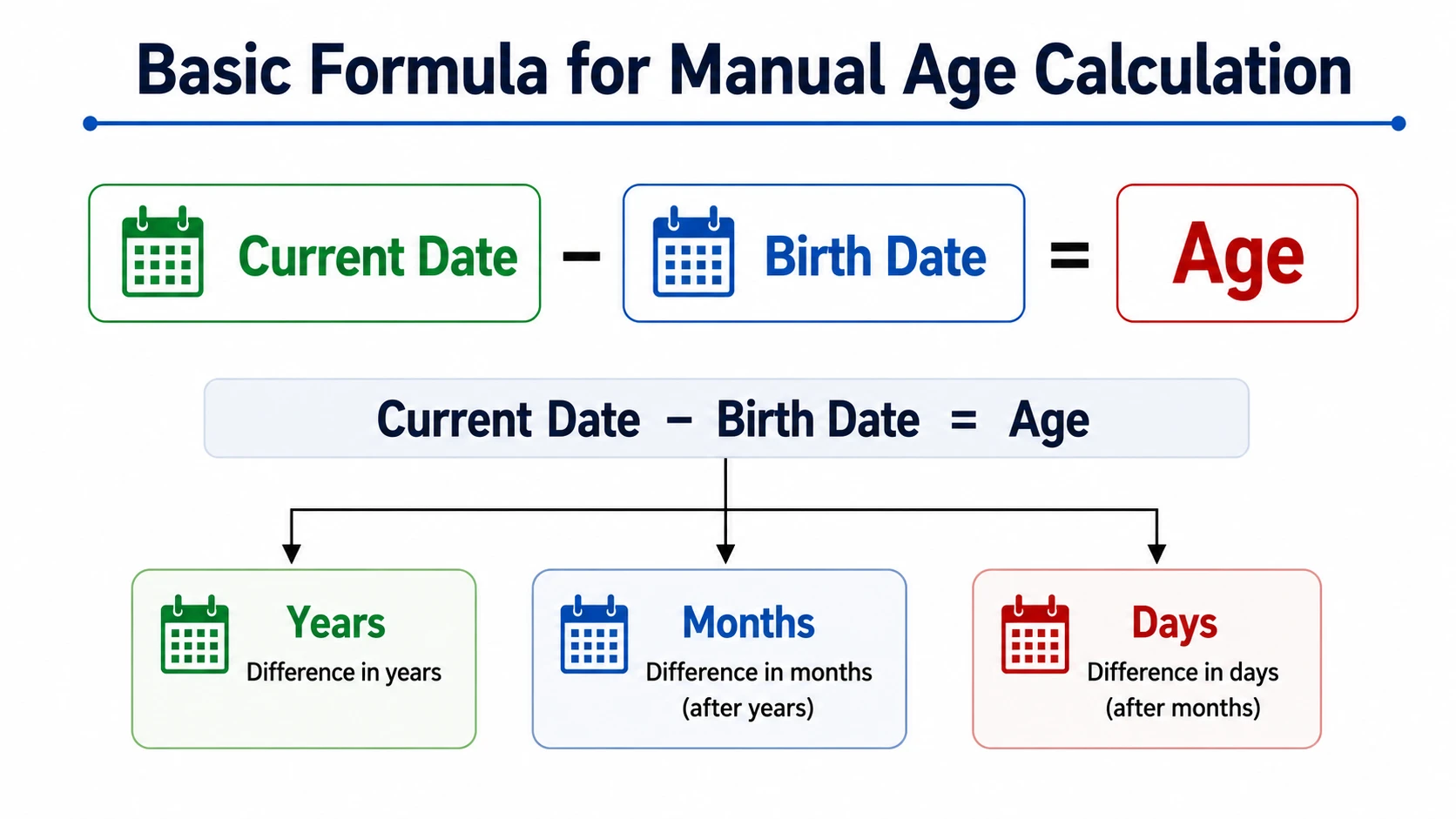
But in real-world calendar calculations, you must subtract:
Years
Months
Days
Separately.
For example:
To calculate the exact age:
Subtract the years
Adjust months
Adjust days
Borrow months or days if necessary
This is known as the date subtraction method.
Step-by-Step Method to Calculate Age Manually
This is the most reliable way to calculate age from date of birth manually.
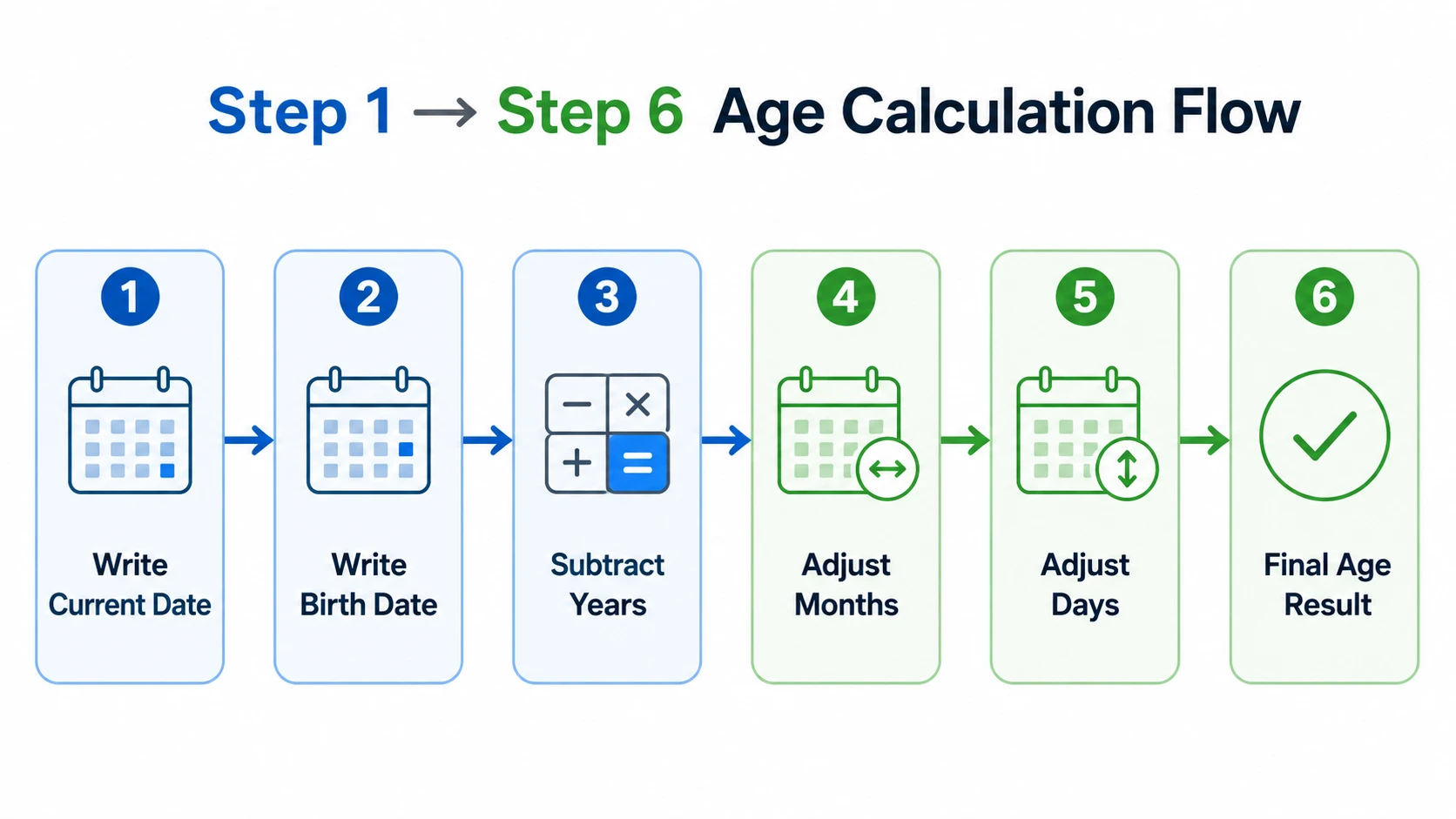
Quick Framework Before You Start
A useful framework many people follow is:
This framework helps you understand the complete process of manual date of birth calculation before starting the step-by-step method.
Step 1 – Write the Current Date
Start with the present date or the target date on which you want to calculate age.
Example:
Always keep the format consistent to avoid confusion.
Step 2 – Write the Date of Birth
Now write the person’s birth date directly below the current date.
Example:
Your setup should now look like this:
Current Date 11 05 2026
Date of Birth 24 08 1998
Step 3 – Subtract the Years
Subtract the birth year from the current year.
2026 − 1998 = 28
However, this is only the preliminary value.
You must still check:
Has the birthday already occurred this year?
Are the current month and day smaller than the birth month and day?
In this case:
May comes before August.
So the birthday has not happened yet in 2026.
Therefore:
28 − 1 = 27 years
Step 4 – Adjust Months and Days
Now compare the months.
Current month:
May (05)
Birth month:
August (08)
Since 05 is smaller than 08, month borrowing becomes necessary.
This is where many manual calculations go wrong.
Step 5 – Borrow Days or Months if Needed
When the current day is smaller than the birth day, you cannot subtract directly.
Example:
Current day = 11
Birth day = 24
You cannot do:
11 − 24
So you borrow days from the previous month and reduce the month count by 1 before continuing the subtraction.
Worked Example of Manual Age Calculation
Let’s solve a complete example step by step.
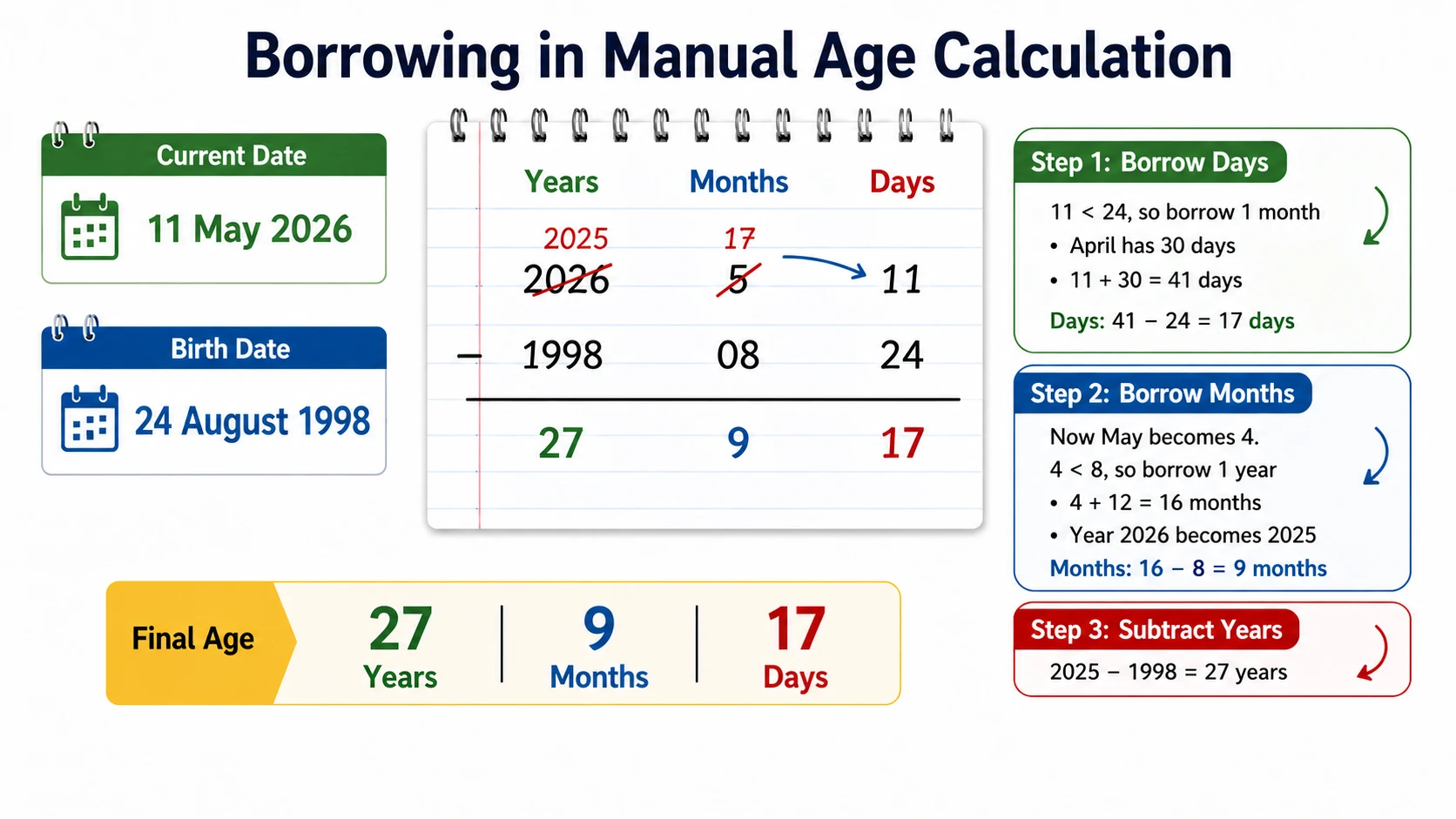
Example
Step 1 – Years
2026 − 1998 = 28
But May comes before August.
So:
28 − 1 = 27 years
Step 2 – Months
Since:
Current month = 05
Birth month = 08
Borrow 1 year.
12 + 5 = 17 months
17 − 8 = 9 months
Step 3 – Days
Current day:
11
Birth day:
24
Borrow days from the previous month.
Suppose April has 30 days.
11 + 30 = 41
41 − 24 = 17 days
Final Answer
So the exact age is:
27 years, 9 months, and 17 days
Want to avoid manual steps and get instant accurate results?
CASE STUDY: School Admission Age Verification Error
A real situation occurred where a parent was checking school admission eligibility for their child.
The school required:
Minimum age of 5 years before 1 April 2025.
Child’s Date of Birth:
12 April 2020
Step 1 – Incorrect Quick Check
At first, a simple calculation was done:
2025 − 2020 = 5 years
So it looked like the child was eligible for admission.
Step 2 – Manual Age Verification
However, when the exact manual age calculation was performed:
The birthday (12 April) had NOT occurred yet on 1 April 2025.
So, 5 full years were NOT completed.
Actual age:
4 years, 11 months, and 20 days
Step 3 – Final Result
The child was NOT eligible for admission.
Key Learning
This case clearly shows the following:
Year-only subtraction is not enough.
Month and day adjustments are critical.
Small date differences can change eligibility.
👉 This is why manual age calculation must always include full calendar logic.
PERSONAL STORY: Why I Stopped Trusting Simple Age Subtraction
At one point while checking eligibility for a form, I also made the same mistake many people do.
I quickly subtracted the years and assumed the result was correct, but after rechecking the birthday date, I realized the calculation was wrong.
What looked like a correct answer at first turned into a completely different result after proper manual checking.
That moment made it clear:
Age calculation is not just subtraction — it is calendar logic.
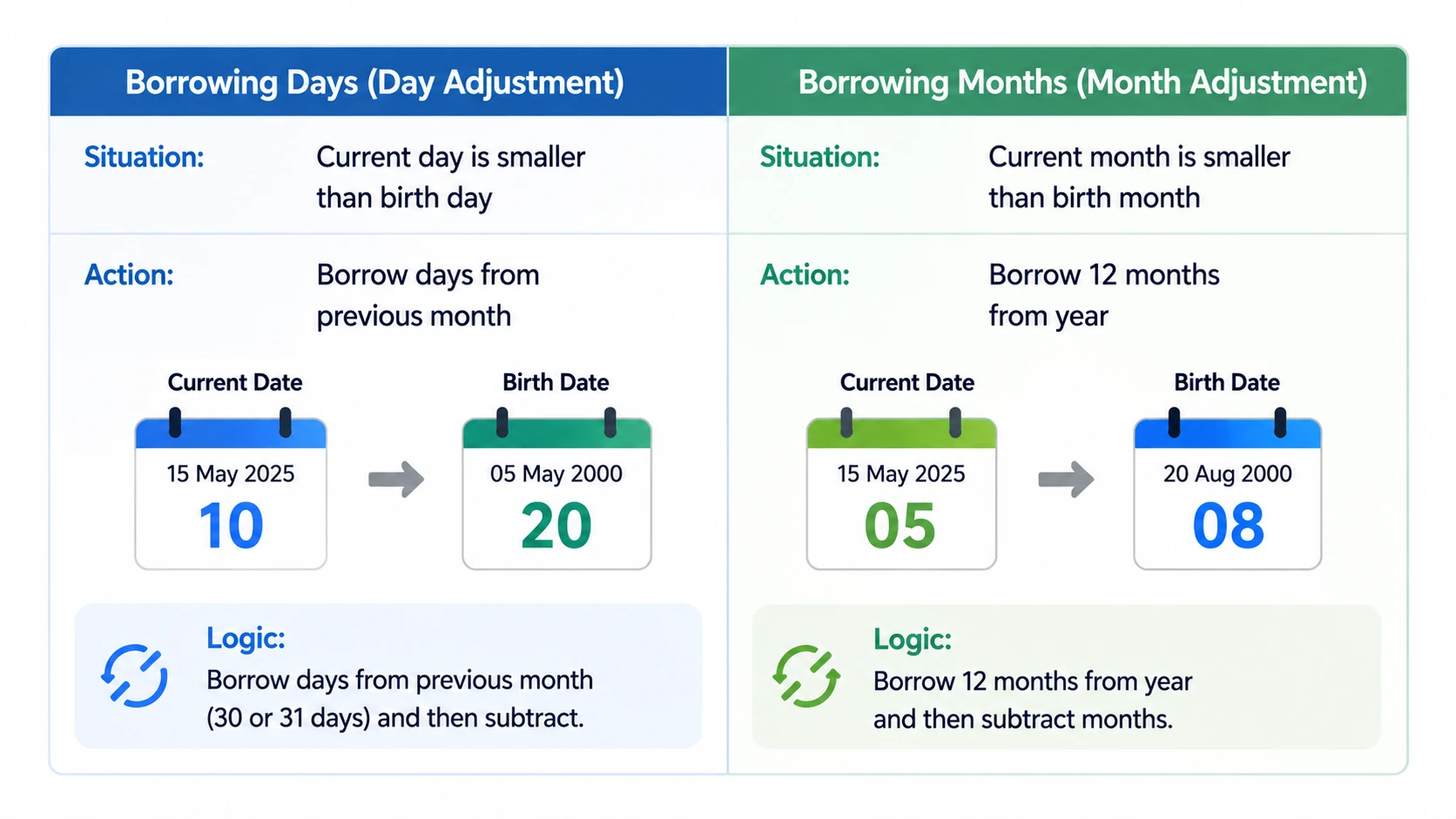
How Borrowing Works in Date Calculations
This is one of the most misunderstood parts of manual age calculation.
Most people know basic subtraction, but calendar subtraction behaves differently because months do not all contain the same number of days.
Borrowing Days
Suppose:
Current day = 5
Birth day = 18
You cannot subtract:
5 − 18
So you borrow from the previous month.
If the previous month had:
31 days
Then:
5 + 31 = 36
36 − 18 = 18 days
Borrowing Months
If the current month is smaller than the birth month:
Borrow 1 year
Convert it into 12 months
Example:
Current month = 3
Birth month = 9
3 becomes:
15 months
15 − 9 = 6 months
Why Month Length Matters
Different months contain:
28 days
29 days
30 days
31 days
That means the borrowing value changes depending on:
February
Leap years
Calendar month lengths
This is why exact calendar adjustment matters.
Let’s analyze a real-world case in detail.
A Simple Manual Age Calculation Framework
Through testing different teaching methods, one framework consistently makes calculations easier for beginners.
The “Y-M-D” Method (Years, Months, Days)
Always calculate in this order:
This prevents confusion and reduces mistakes during borrowing.
Instead of randomly subtracting dates, you:
Handle years first
Adjust months second
Solve days last
This method is easier to remember during exams, interviews, and paper-based forms.
Common Problems When Calculating Age Manually
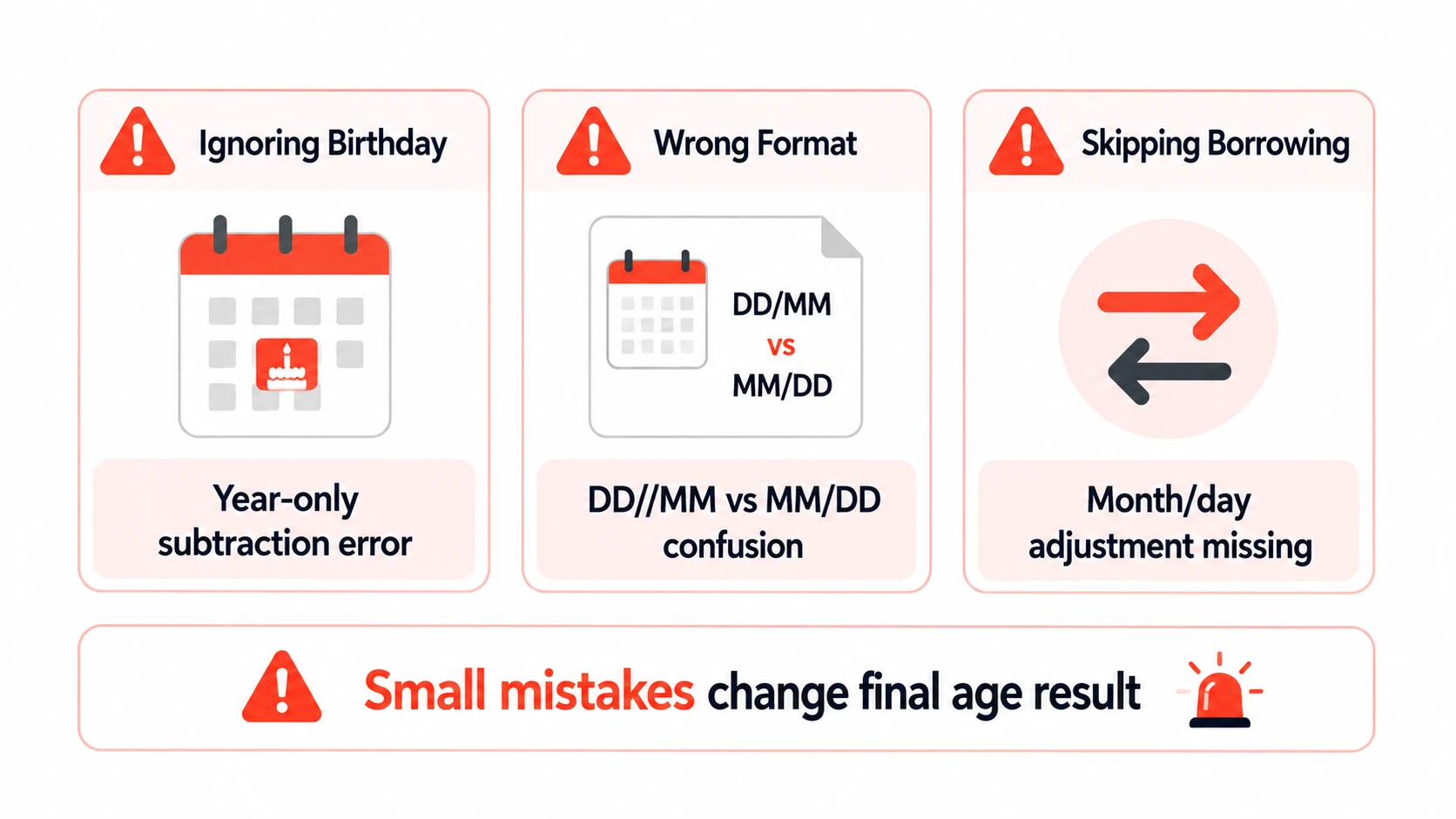
People commonly make mistakes while trying to calculate age without a calculator. These errors usually happen when small details like months, formats, or borrowing rules are ignored.
Most Common Beginner Mistake
A very common mistake is subtracting only the birth year from the current year without checking whether the birthday has already occurred.
For example:
Date of Birth: December 2000
Current Date: January 2026
Many people incorrectly assume:
“26 years old”
But the correct age is
25 years old
This is because the birthday in December has not happened yet in 2026, so one full year cannot be counted.
Some Other Frequent Issues
Apart from this, there are several other common mistakes people make during manual age calculation:
Confusing date formats (DD/MM/YYYY vs MM/DD/YYYY)
Forgetting to adjust months after subtracting years
Incorrect borrowing of days or months
Ignoring leap years in longer date ranges
Assuming all months have 30 days
Why This Matters
These small mistakes can completely change the final age result, especially in cases like school admissions, job applications, or official documentation where exact age matters.
Using an age calculation tool can help verify manual results instantly.
We will discuss these issues in more detail in our upcoming guide on age calculation mistakes.
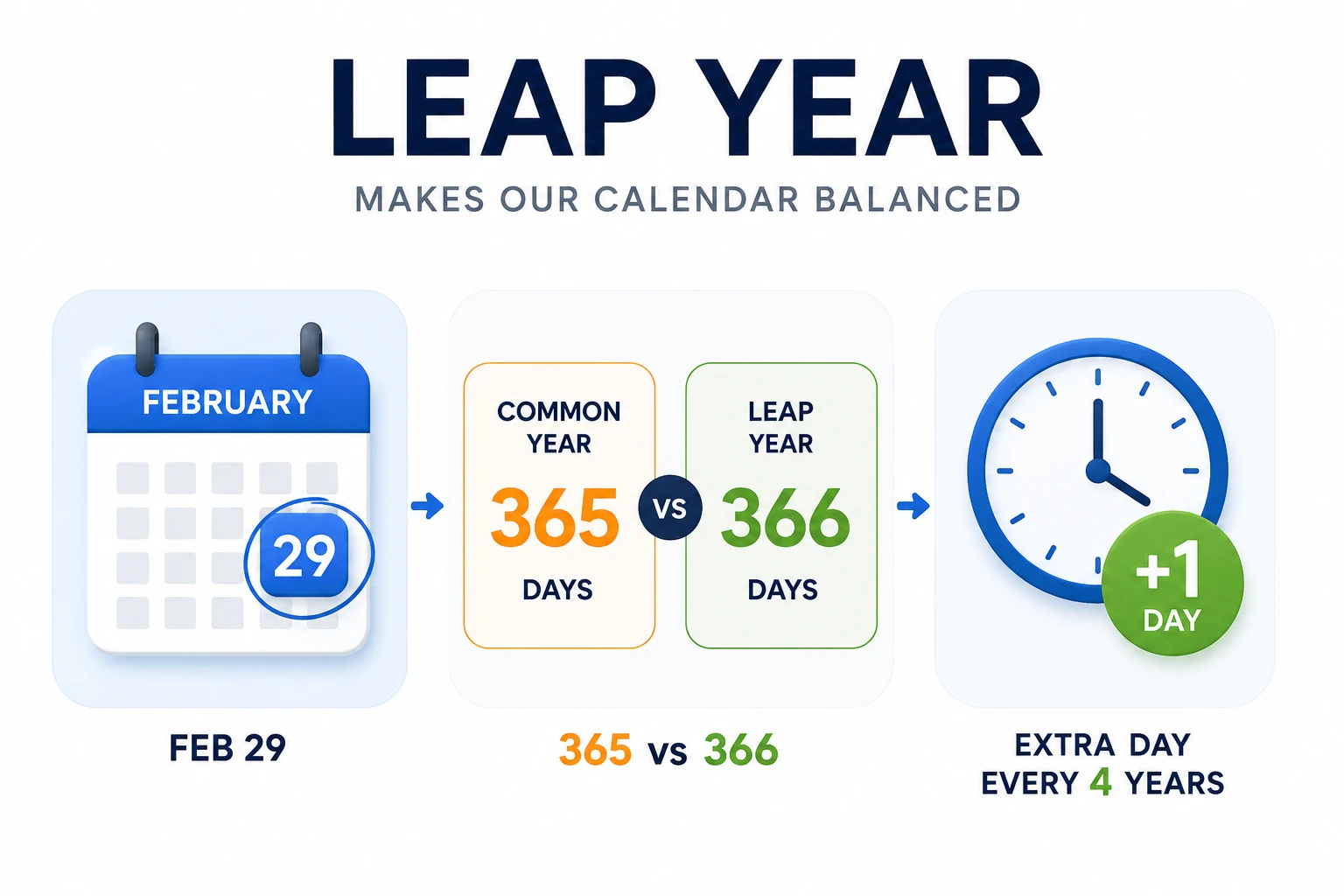
How Leap Years Affect Manual Age Calculations
Leap years slightly change date calculations because some years contain the following:
366 days instead of 365
The most common leap year situation involves:
February 29
Someone born on February 29 may celebrate birthdays differently during non-leap years, which can affect exact calculations.
Manual calculations become more difficult when:
Date ranges cross multiple leap years
February adjustments are involved
Long-term durations are calculated
This is why careful calendar calculation matters. We will explain this in more detail in a dedicated guide on leap year calculations.
Manual Age Calculation vs Online Calculators
After manually testing several date calculations, one thing becomes obvious:
Manual methods are educational, but digital tools are faster for repeated calculations, you can also use an online age calculator tool for instant and accurate results.
However, learning the manual process helps you:
Understand date logic
Verify automated results
Avoid blind dependence on software
This is especially useful in academic or verification situations.
When Manual Age Calculation Is Useful
Many people assume manual age calculation is outdated, but it still has practical uses.
Manual age calculation is still useful in:
School admission verification
Government and paper-based forms
Competitive exams with age limits
HR eligibility and retirement checks
Offline situations without internet access
Understanding manual calculation also helps people avoid common mistakes in forms, eligibility checks, and official documentation.
FAQs
You calculate age by subtracting the date of birth from the current date and then correcting the result using calendar logic. If the birthday has not occurred in the current year, you reduce one year and adjust calendar values for months and days accordingly.
The basic formula is:
Current Date − Date of Birth = Age
In real situations, this becomes more detailed because months and days must also be adjusted. Since calendar months have different lengths and leap years exist, simple subtraction is not enough for exact results.
First, write both dates clearly. Subtract the years, then check whether the birthday has already occurred in the current year. After that, correct date differences using borrowing rules for months and days to get the exact age.
Why do people make mistakes in age calculation?
Most mistakes happen due to ignoring whether the birthday has passed, confusion in date formats, or incorrect month/day borrowing. Many people also assume all months have equal length, which leads to inaccurate results.
Leap years add an extra day in February, making some years 366 days long. This mainly affects long time spans and calculations involving February 29, where exact age tracking becomes slightly more sensitive.
If the current day is smaller than the birth day, you borrow days from the previous month. If the current month is smaller than the birth month, you borrow 12 months from the year and adjust the calculation to complete it accurately.
The easiest method is to subtract years first, then adjust months and days based on whether the birthday has already occurred. This step-by-step approach helps ensure accuracy without needing a calculator.
Manual age calculation is important for school admissions, job applications, and official documentation where exact age matters. It also helps build a clear understanding of how calendar-based time calculation works instead of relying only on digital tools.
Conclusion
Learning how to calculate age manually is still useful in many real-world situations, especially where exact date verification matters. Although calculators and digital tools make the process faster, understanding the underlying date arithmetic helps prevent common mistakes involving months, days, and leap years.
By following a proper manual age calculation method, using correct borrowing logic, and carefully adjusting dates, you can determine exact age more accurately without relying entirely on software.
Whether you are verifying eligibility for school admissions, completing official forms, or simply learning how chronological age works, understanding the manual process builds stronger confidence in date-based calculations.
For faster results, digital tools can also help simplify age calculation using an online calculator.