How Leap Years Affect Age Calculation (And Why Different Systems Give Different Results)
May 23, 2026
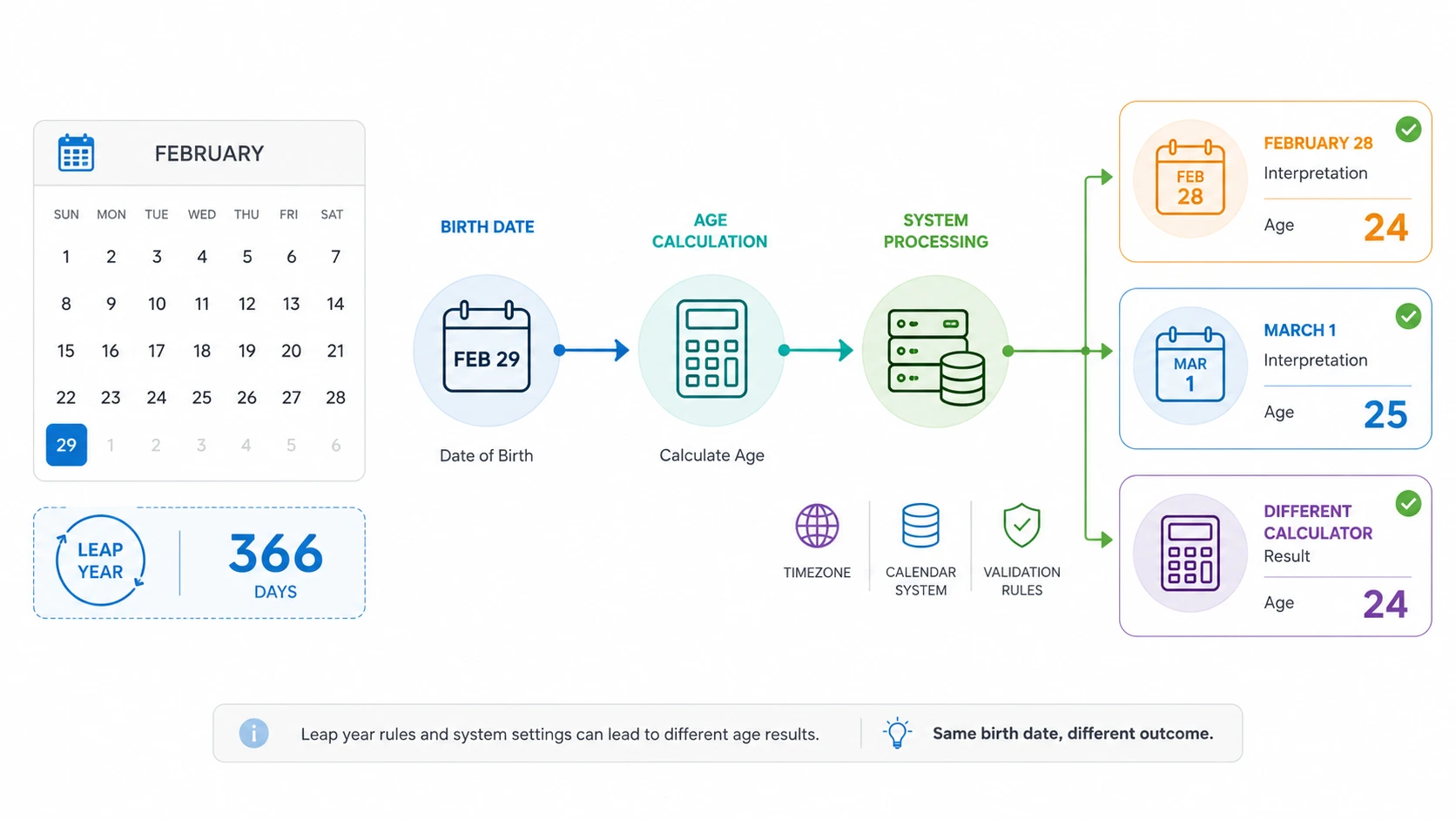
Many people assume age calculation is simple because they only focus on subtracting one year from another. In reality, how leap years affect age calculation is far more complex than most people realize. Even a single extra calendar day can change exact age results, eligibility verification, database interpretation, and date-based calculations across different systems — and in some cases, it can even influence whether someone qualifies or not.
The confusion becomes more noticeable when dealing with February 29 birthdays, long-term date calculations, school admission cutoff dates, retirement eligibility, immigration records, and automated verification platforms.
While checking a few real-world age calculators and verification tools, what surprised me wasn’t just that results differed — it was how inconsistent the logic actually was across tools that looked almost identical on the surface. The same birth date didn’t always return the same result. In some cases, February 29 was treated as February 28, while in others the system pushed it to March 1. One tool even kept the raw date logic without applying any adjustment at all.
That’s where things start to get interesting — leap year age calculation becomes one of the most misunderstood areas in calendar arithmetic and date verification systems.
Understanding how leap years affect age calculations is important because modern systems rely heavily on automated date processing and real-time age verification systems used across HR portals, government databases, and immigration systems where accuracy is critical. You can verify your own result instantly using our free online age calculator tool.
In practice, this becomes visible in small but noticeable ways. For example, someone applying for school admission or visa eligibility might check age across two different websites and notice a one-day mismatch. It may look minor, but in official systems, even a single day can change eligibility outcomes.
Why Leap Years Exist in the Calendar System
Before understanding how leap years affect age calculation, it helps to understand why leap years exist in the first place.
A normal calendar year contains:
365 days
However, Earth actually takes approximately:
365.2422 days
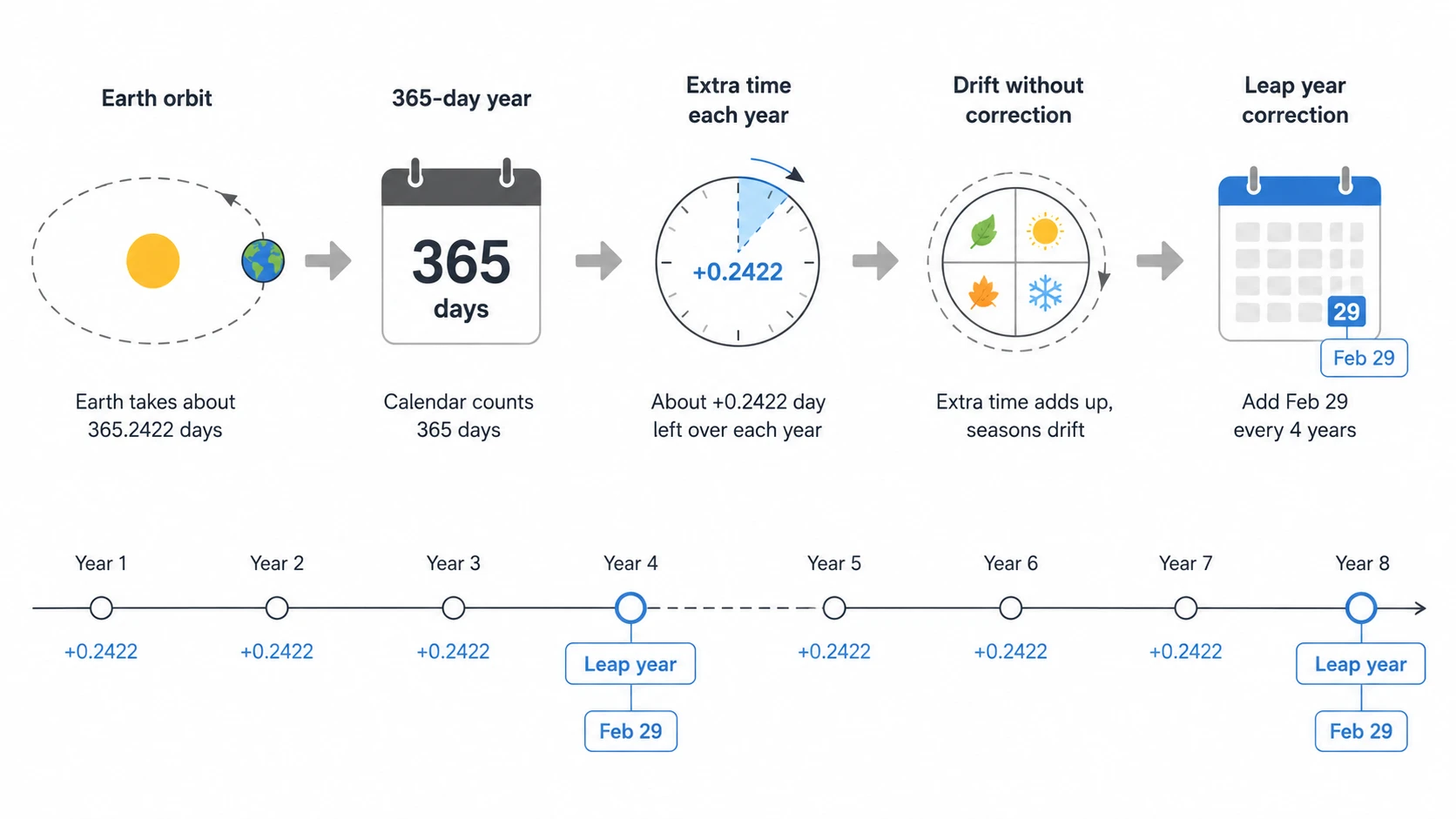
to complete one orbit around the sun.
Without this correction, the calendar would drift away from real seasonal timing over time, as explained in the Gregorian calendar system explained.
That extra day becomes:
February 29
This process is called a:
leap year adjustment
The system helps maintain long-term calendar alignment and prevents seasonal drift across centuries.
However, this small adjustment creates surprisingly complicated situations in:
chronological age calculation
official date verification
timestamp systems
historical records
and automated database calculations.
Leap Year Rule Structure
These exceptions are part of the official leap year rules in the Gregorian calendar, which define when extra calendar days are added.
How Leap Years Change Normal Age Calculations
Most people calculate age like this:
2026−2000=26
But exact age calculation does not work using years alone. Real age verification systems evaluate the following:
months
days
leap-year adjustments
whether a birthday has already occurred
Leap years slightly alter:
total days lived
date intervals
chronological calculations
long-term age tracking
For example, a person born in March 2000 and another born in April 2000 may technically have different total day counts because their lifetime crosses different leap-year boundaries depending on the exact dates involved.
In real-world systems, this matters because medical systems, HR records, retirement timelines, and official documentation all depend on accurate date handling. Even though both individuals may appear to be the same age in years, their total lived days can differ slightly.
Check Your Exact Age Instantly (Free Tool)
Example of Leap-Year Impact on Total Days
In practice, I once compared two cases using the same birth year (2004) but different age calculators. One tool updated the age on February 28, while another only updated it on March 1. The difference was just one day, but it changed how the system interpreted eligibility in that test case.
👉 And that’s usually the point where people realize the issue isn’t the birth date — it’s the system interpreting it differently.
Why February 29 Birthdays Create Special Cases
Among all calendar situations, the most complicated involves people born on:
February 29
This date only exists during leap years.
As a result, many systems must decide how to handle birthdays during years where February 29 does not exist.
This creates:
legal interpretation differences
database inconsistencies
and verification confusion
What Happens in Non-Leap Years?
In non-leap years:
February contains only 28 days.
That means someone born on February 29 technically has no matching calendar date during most years.
Different systems solve this problem differently.
Some use:
February 28
Others use:
March 1
This directly affects:
exact age calculations,
eligibility timelines,
and birthday verification systems.
This is one reason many people search:
How old are people born on February 29?
or
February 29 birthday in non-leap years
because the answer depends partly on the interpretation method being used.
February 28 vs. March 1 Birthday Interpretation
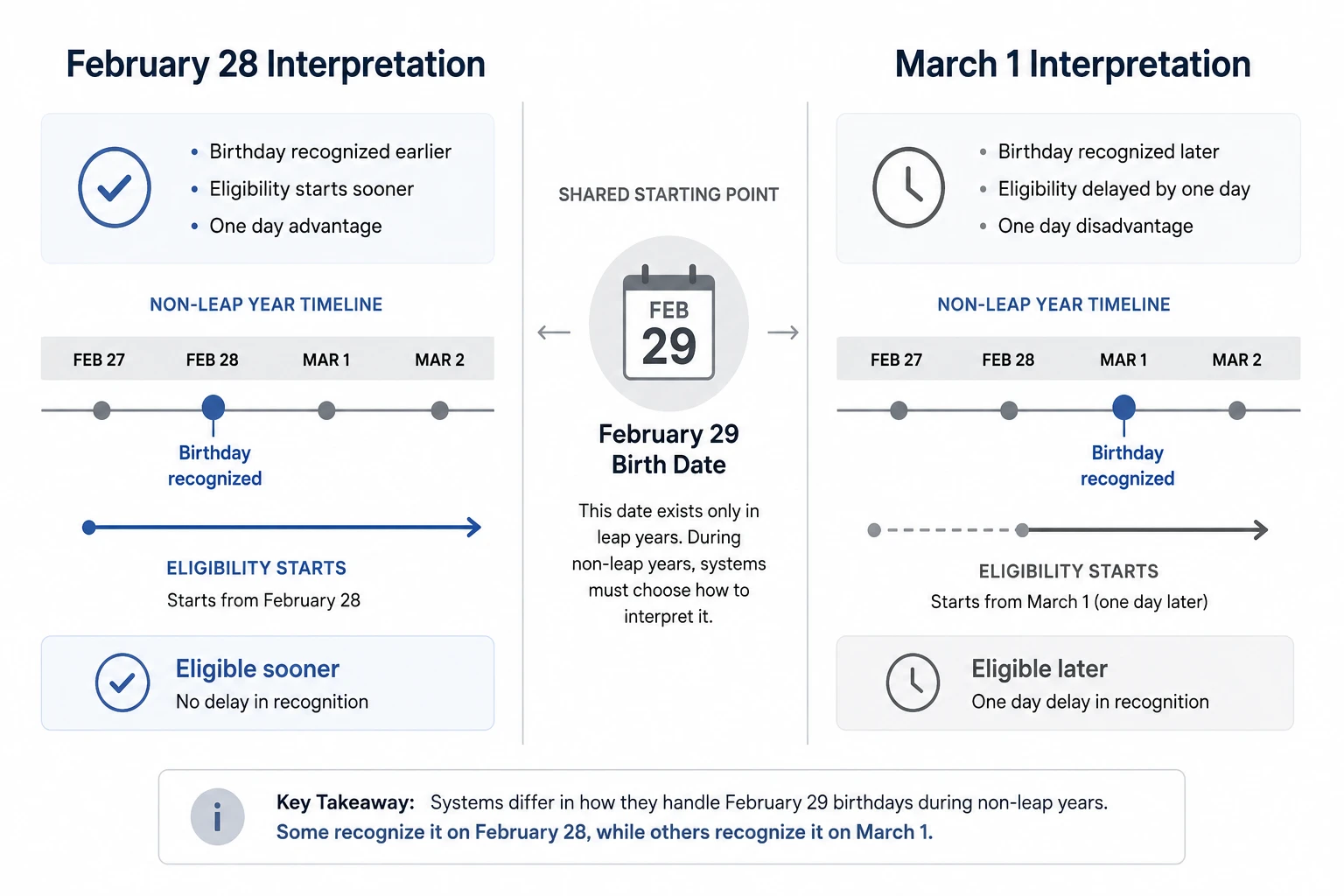
One of the most interesting observations in leap day age calculation is that different countries and organizations sometimes follow different legal interpretations.
Some systems consider:
February 28
as the legal substitute birthday.
Others consider:
March 1
as the next valid calendar completion.
This difference may seem minor, but it can affect:
school eligibility,
retirement dates,
legal adulthood,
and official age verification.
Comparison of Birthday Interpretation Methods
For example:
If a system uses February 28, a person may become officially eligible one day earlier compared to systems that use March 1.
This creates real-world variation across:
schools,
HR systems,
government databases,
and immigration systems.
How Different Systems Handle Leap-Day Birthdays
During testing of multiple online date systems, I noticed inconsistent handling of leap-day birthdays across platforms.
In one test, I entered a February 29 birth date into three different calculators back-to-back. What stood out was not just the difference in results, but the logic behind it. One system automatically rounded the date to February 28, another pushed it forward to March 1, while the third didn’t adjust the date at all and kept the original logic.
Here’s what each system did in practice:
One calculator automatically adjusted the birthday to February 28.
Another shifted the calculation to March 1.
A third system kept raw calendar subtraction without any adjustment.
Interestingly, all three systems still claimed to produce accurate results, even though the outputs were slightly different.
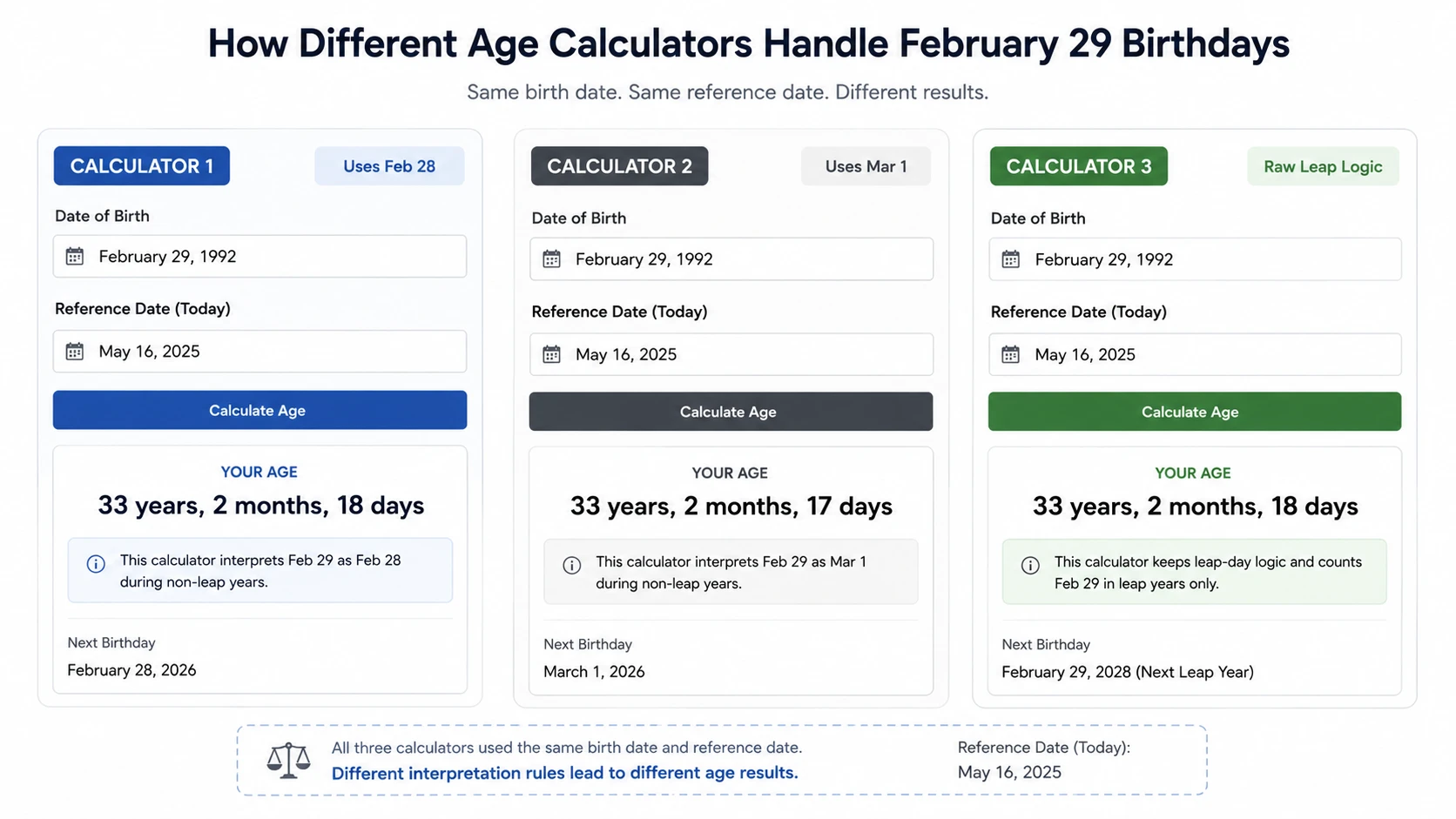
This highlights an important point: the issue is usually not the birth date itself, but how each system interprets calendar rules and leap-year logic.
That’s why users sometimes notice differences in results when using age calculators, even when the same birth date is entered across platforms.
During testing of multiple online date systems, I noticed inconsistent handling of leap-day birthdays across platforms.
In one case I tested, I entered a February 29 birth date into three different calculators back-to-back. What surprised me was not just the difference, but the logic behind it. One system rounded it to February 28 automatically, another delayed it to March 1, and the third didn’t adjust anything at all.
One calculator:
automatically adjusted the birthday to February 28.
Another:
shifted calculations to March 1.
A third system:
maintained raw calendar subtraction logic without automatic adjustment.
Interestingly, all three systems claimed to provide “accurate” results, yet each produced slightly different outputs.
This demonstrates an important point:
The issue is usually not the birth date itself — the issue is how different systems interpret calendar logic and leap-year handling rules.
This is why users sometimes notice:
why different age calculators show different results
even when entering the exact same date.
Why Manual Age Calculations Become More Difficult During Leap Years
Manual age calculation already becomes confusing because:
months contain different numbers of days,
borrowing rules vary
and calendar subtraction behaves differently from normal arithmetic.
Leap years add another layer of complexity. To understand the full breakdown, see our guide on how to calculate age manually step by step with real examples.
Now calculations must also account for:
366-day years,
February 29 adjustments,
and varying leap-year intervals.
This increases the likelihood of:
incorrect borrowing,
day-count mistakes,
and verification discrepancies.
For example:
A manual calculation spanning:
20 years
may cross:
5 leap years
which changes total day calculations significantly.
Many people performing manual subtraction forget to include these additional days entirely.
This is one reason exact age calculation becomes difficult without structured date-handling systems.
Common Manual Calculation Problems
How Online Age Calculators Handle Leap Years Automatically
Modern systems simplify these calculations using:
automated date arithmetic,
built-in calendar logic,
and structured date verification algorithms.
If you want to understand how these systems work in practice, our online age calculator to get exact age in years, months and days breaks it down in detail.
A properly designed online age calculator automatically:
checks leap-year intervals,
adjusts February length,
handles month differences,
and processes chronological age accurately.
Instead of manually counting days, the system performs:
calendar-aware subtraction.
This reduces:
human error,
inconsistent borrowing,
and incorrect age verification.
Most modern calculators rely on:
Gregorian calendar age calculation
logic for accurate results.
However, even digital systems may differ slightly depending on:
programming rules,
leap-day interpretation,
UTC handling,
and regional calendar configuration.
Why Different Calculators Sometimes Show Different Results
This is one of the least-discussed but most important areas of age calculation differences.
Many people assume all calculators follow identical rules. This is one of the common age calculation mistakes that cause wrong results, especially when different systems use different logic.
They do not.
Different systems may vary because of:
leap-year interpretation,
time zone conversion,
UTC processing,
date formatting,
server logic,
and birthday adjustment methods.
For example:
One system may:
calculate age based purely on local dates.
Another may:
process timestamps using UTC conversion.
This becomes especially important near:
midnight transitions,
international records,
and global verification systems.
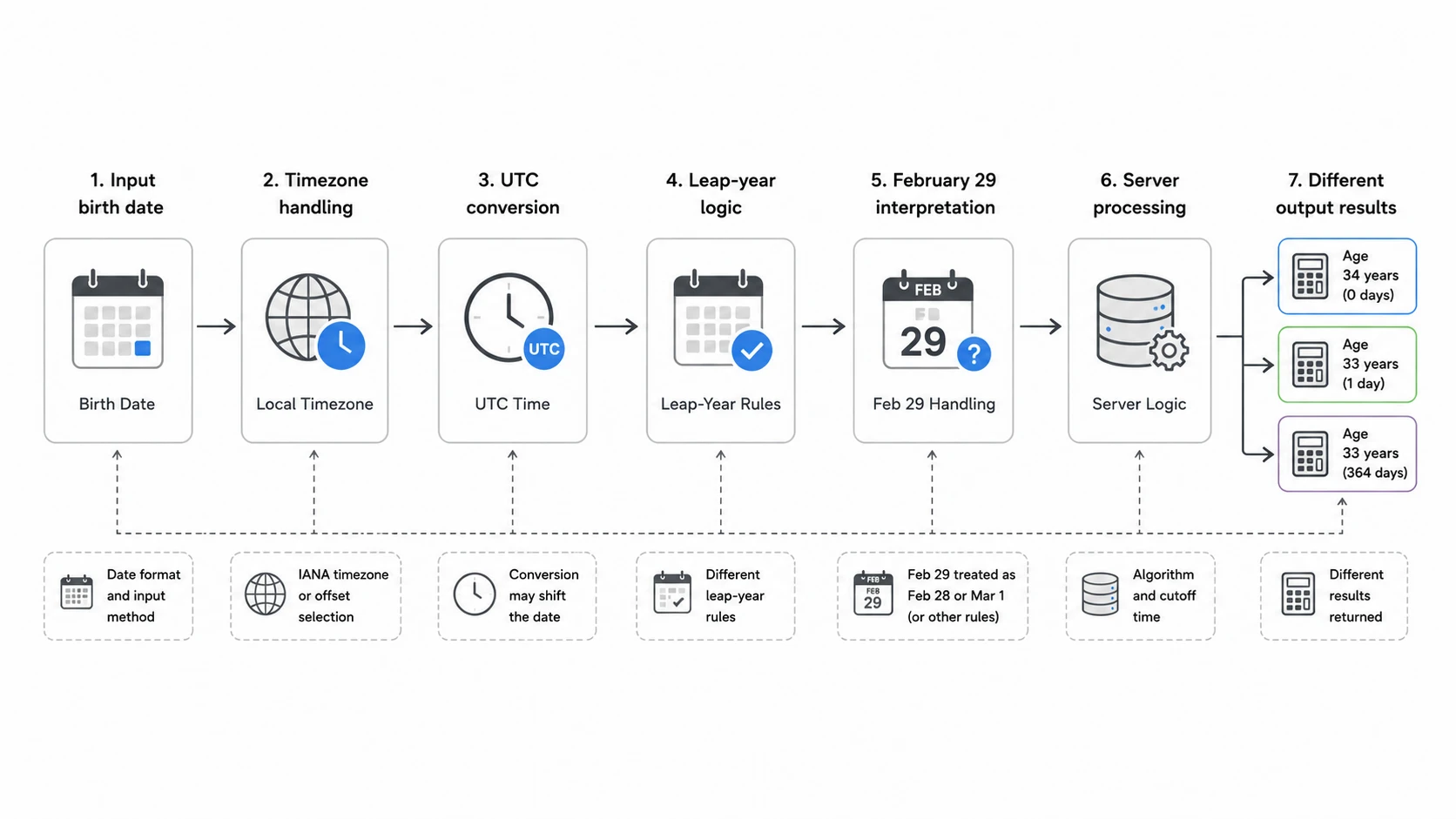
In one structured comparison test, identical birth data produced different outputs across two platforms because one stored the date using local timezone logic while the other normalized everything into UTC format.
That small backend difference slightly changed the final result.
This is a common outcome when date calculation systems rely on different internal date logic.
Why Systems Produce Different Results
Leap Year Problems in School, HR & Government Verification
Leap-year handling becomes especially important in:
schools,
HR departments,
immigration systems,
passport records,
and medical databases.
These environments often rely on:
strict cutoff dates,
legal verification,
and automated eligibility systems.
School Admission Example
Suppose a school requires:
minimum age before March 1.
A child born on:
February 29
may be interpreted differently depending on whether the institution recognizes:
February 28
orMarch 1
as the legal birthday during non-leap years.
This can affect:
admission eligibility,
exam registration,
and age-sensitive applications.
HR & Retirement Systems
HR systems also depend on exact date verification because:
retirement calculations,
pension eligibility,
and employment compliance
often rely on precise chronological age.
Even small differences involving leap-year interpretation can create:
verification delays,
payroll inconsistencies,
or document mismatch issues.
Real-World Verification Areas
Common Misunderstandings About Leap Years
Many misconceptions about leap years still circulate online.
Some are surprisingly common even in official environments.
“Every 4th Year Is a Leap Year” Myth
Most people believe:
Every fourth year automatically becomes a leap year.
That is not completely correct.
Under the Gregorian calendar, century years behave differently.
For example:
1900 was NOT a leap year.
2000 WAS a leap year.
This happens because century years must also be divisible by the following:
400
to qualify as leap years.
This correction prevents long-term calendar drift over centuries.
Century-Year Exceptions
These exceptions rarely affect daily life directly, but they still matter in:
historical records,
archival systems,
long-term calculations,
and advanced date verification systems.
Without these adjustments, calendars would slowly become inaccurate over time.
This is one reason modern systems rely heavily on:
structured calendar calculations
rather than simple year subtraction.
How Leap Years Affect Total Days Lived
This is one of the most overlooked areas of chronological age calculation.
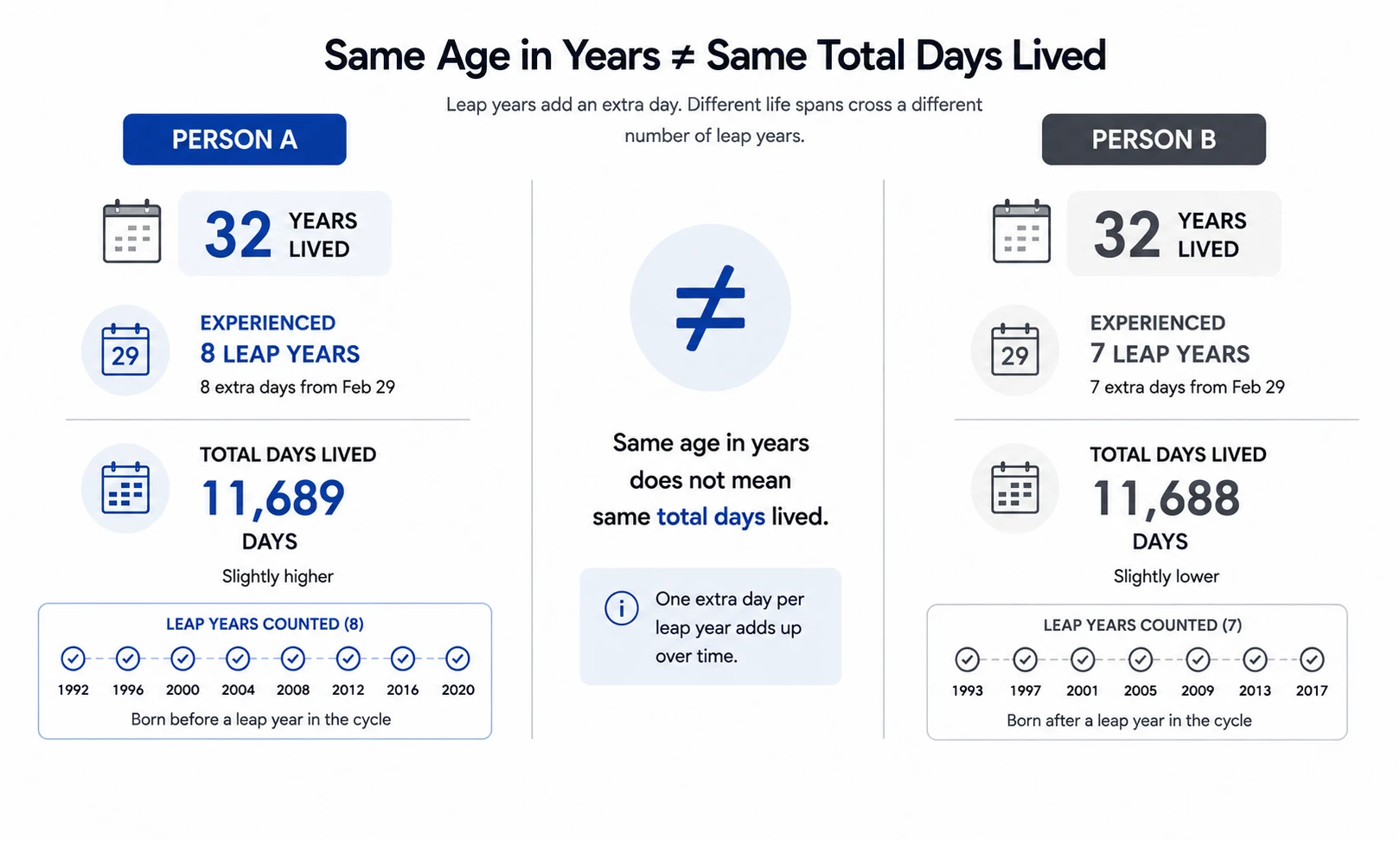
Two people with the same age in years may not have lived the exact same number of days.
Why?
Because leap years introduce:
extra calendar days.
For example:
A person who has lived through:
8 leap years
has technically experienced:
8 additional calendar days
compared to someone whose lifespan crossed fewer leap-year boundaries.
This becomes important in:
medical statistics,
scientific timelines,
long-term research,
and actuarial calculations.
It also explains why some systems display:
total days lived,
total hours,
or total minutes
instead of showing only years and months.
Example Comparison
Even though both are 32 years old, the total day count differs slightly.
When Leap-Year Accuracy Actually Matters
Many casual situations do not require perfect leap-year precision.
However, exact calculations become important in:
school admissions,
retirement systems,
passport verification,
immigration processing,
medical records,
insurance systems,
and legal documentation.
In these environments, even:
one incorrect day
can affect:
eligibility,
compliance,
or verification status.
Leap-year logic matters most when:
exact age verification is required,
long-term records are processed,
Legal cutoff dates are involved.
This is why many organizations use structured digital systems instead of relying on rough manual subtraction.
Why Modern Age Calculators Use Gregorian Calendar Logic
Modern calculators rely on the Gregorian calendar because it provides:
standardised date correction,
leap-year consistency,
and predictable calendar behavior.
Without this structured system:
long-term calculations,
age verification,
and historical timelines
would quickly become inconsistent.
Proper date systems must account for:
leap-year intervals,
month-length differences,
calendar exceptions,
and chronological sequencing.
This is why reliable systems use:
automated date arithmetic,
leap-year adjustment logic,
and structured validation methods
instead of simple year subtraction alone.
Voice Search Questions
Why do leap years affect age calculation?
Leap years slightly change total day counts because some years contain 366 days instead of 365. This affects exact chronological calculations and long-term date verification.
How do calculators handle February 29 birthdays?
Different systems may interpret leap-day birthdays differently during non-leap years. Some use February 28, while others use March 1.
Why is my age different on different calculators?
Different platforms may use different leap-year handling methods, timezone processing, or date interpretation logic.
Do leap years change your real age?
Leap years do not change your biological age, but they can slightly affect exact calendar-based calculations and total days lived.
FAQs
Leap years add an extra day (February 29) every four years, which changes how total time is measured in long-term date calculations.
This becomes noticeable in digital systems where even a single extra day can slightly shift exact age results or verification outputs.
In most systems, people born on February 29 are assigned either February 28 or March 1 in non-leap years.
The choice depends on whether the system prioritizes earlier recognition or full calendar completion, which can slightly change official timing in records.
The differences come from how each calculator processes leap years, timezone rules, UTC conversion, and birthday adjustments.
What makes this interesting is that two tools can use the same input but still produce different outputs because their internal logic is not standardized.
Leap day birthdays follow two main interpretations: some systems shift them to February 28, while others move them to March 1.
Both approaches are widely used, but they reflect different system design choices rather than calculation errors.
The presence of an extra day affects how long durations are measured between two dates.
This is why small differences can appear in systems that calculate age down to exact day-level precision.
Modern calculators rely on Gregorian calendar logic, which automatically accounts for leap years and adjusts date differences internally.
In most cases, this reduces inconsistencies and ensures more stable results across platforms.
Age calculations differ because systems do not always use the same rules for leap years, timezone handling, UTC conversion, or birthday interpretation.
Even when the same data is entered, backend logic differences can produce slightly different results.
Leap years affect age by adding an extra day every four years, which slightly changes how total time is measured in date-based systems and chronological calculations.
A leap year does not change your actual birthday, but in non-leap years, systems may interpret February 29 birthdays as either February 28 or March 1.
Yes, February 29 is the rarest birthday because it only occurs once every four years during leap years.
In simple terms, leap years don’t change your age, but they do change how systems calculate your age — and that difference is where most confusion comes from.
Conclusion
At first glance, age calculation feels like a straightforward subtraction between two dates. But once leap years enter the picture, the process quietly becomes more sensitive than most people expect.
What makes it interesting is not just the extra day itself, but how differently systems respond to it. A small change like February 29 being shifted to February 28 or March 1 is enough to explain why results don’t always match across tools, even when the same birth date is entered.
This is also why how leap years affect age calculation keeps appearing in real-world inconsistencies — from February 29 birthdays to eligibility checks in automated systems. The logic behind age calculation is not always uniform, and that lack of standardisation is where most confusion begins.
In the end, accurate age calculation depends less on the birth date alone and more on how that date is interpreted by the system processing it — whether through leap-year rules, timezone handling, or calendar logic.
That’s why even in modern digital environments, age is not just a simple number — it is a result of multiple layers of data interpretation working behind the scenes.
Try the Free Age Calculator Tool