Common Age Calculation Mistakes That Cause Wrong Results (And How to Avoid Them)
May 19, 2026
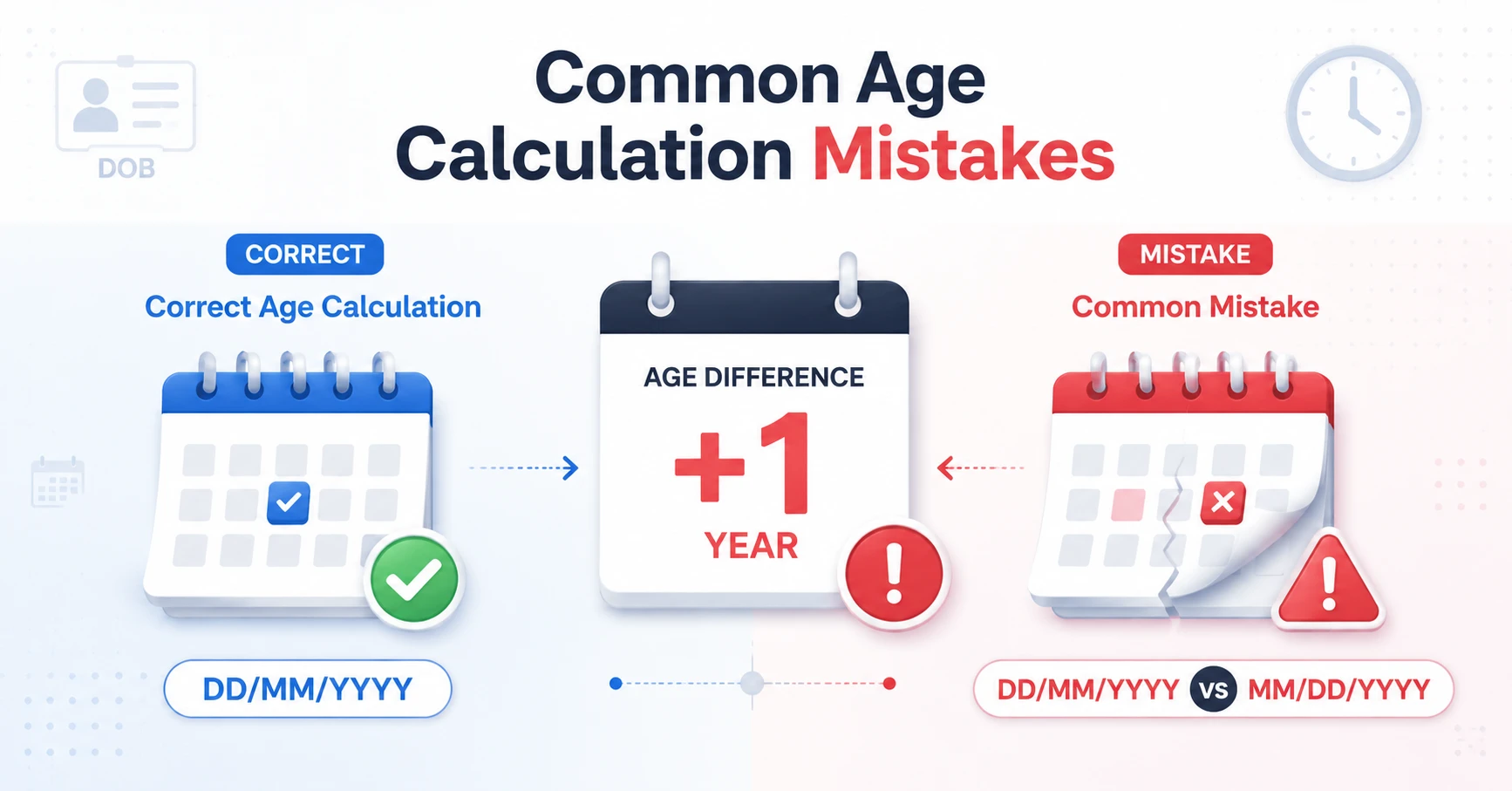
A surprising number of people make common age calculation mistakes without even realizing it. In many cases, even a small difference of a few days or a single month can change outcomes such as admission eligibility, job selection, retirement calculations, or official verification results.
In real-world age calculation systems, the result is not based only on simple year subtraction. Most platforms evaluate the complete date of birth, including whether the birthday has already occurred before a specific cutoff date. This is one of the main reasons why age results often differ across systems.
The complexity increases further because age calculation depends on multiple real-world factors such as date format differences, leap year rules, and regional calendar variations. These small differences can lead to inconsistent results even when the same date is used.
These issues are commonly seen in school admissions, HR onboarding, passport applications, visa processing, government documentation, and retirement eligibility checks.
This analysis is based on real-world observation of form-processing systems and date-verification behaviour across multiple platforms.
This guide explains the most common age calculation mistakes, why they happen in real-world systems, and how to avoid them using accurate and consistent date-handling methods.
Using the Wrong Date Format (DD/MM/YYYY vs MM/DD/YYYY)
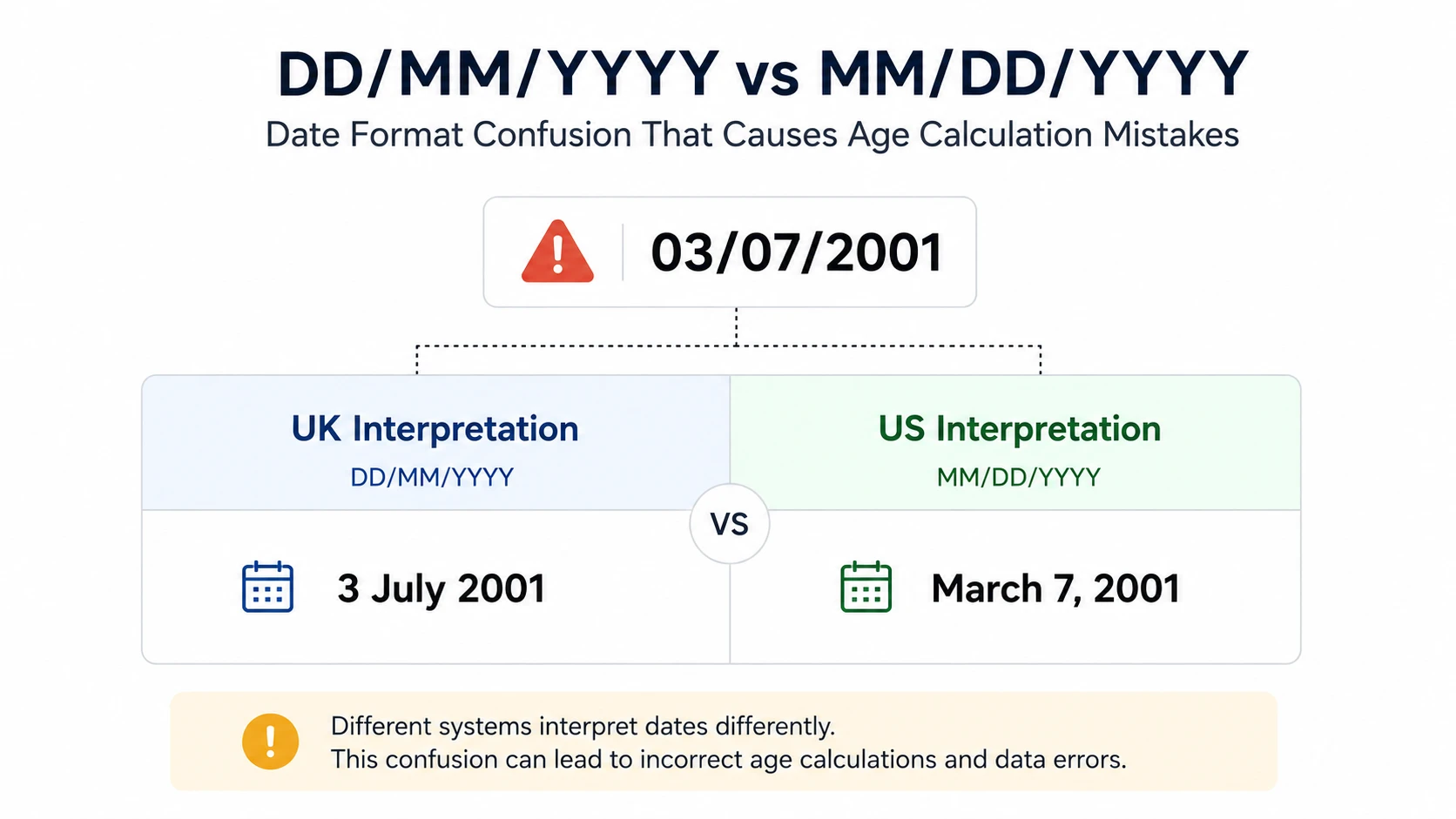
One of the most overlooked problems in age verification is incorrect date formatting.
A date that looks completely normal in one country can mean something entirely different in another.
For example:
That difference may seem small, but in real applications it can create:
rejected forms
DOB mismatches
failed identity verification
incorrect age records
This issue becomes more serious in the following:
international applications
immigration systems
online databases
passport forms
multinational HR systems
In international registration systems, date format mismatches can lead to incorrect DOB interpretation across platforms. In one observed submission case, a birth date entered in UK format was automatically processed using US formatting, which changed the recorded birth month entirely.
The issue was only discovered later during document verification. This type of mismatch is especially common in international systems where users assume date formatting is universally interpreted the same way.
In one structured comparison test across multiple online systems, the same date format was entered:
03/07/2001
Two different interpretation patterns appeared:
System A interpreted it as 3 July 2001 (DD/MM format)
System B interpreted it as March 7, 2001 (MM/DD format)
Because of this difference, both systems produced different age outputs even though the input was identical. Regional formatting differences are one reason international systems may interpret the same birth date differently, especially in countries that follow U.S. date format conventions (MM/DD/YYYY) instead of the DD/MM/YYYY structure commonly used elsewhere.
This indicates that the calculation itself was not the problem — the issue was how each system interpreted the date format.
Most date-of-birth calculation errors happen because of inconsistent date interpretation rather than incorrect mathematical calculation.
This kind of variation is especially important in systems where eligibility or verification depends on exact DOB interpretation rules, making it one of the most common date format mistakes in international submissions.
How to Avoid This Problem
Before submitting any form:
check whether the platform uses DD/MM/YYYY or MM/DD/YYYY
avoid typing shortened dates when possible
Use full month names if allowed
review confirmation pages carefully before final submission
This becomes especially important during:
passport verification
visa applications
school registration
employment onboarding
Forgetting Whether the Birthday Has Already Happened
Another extremely common mistake happens when people subtract only the years without checking whether a birthday has already occurred in the current year.
For example:
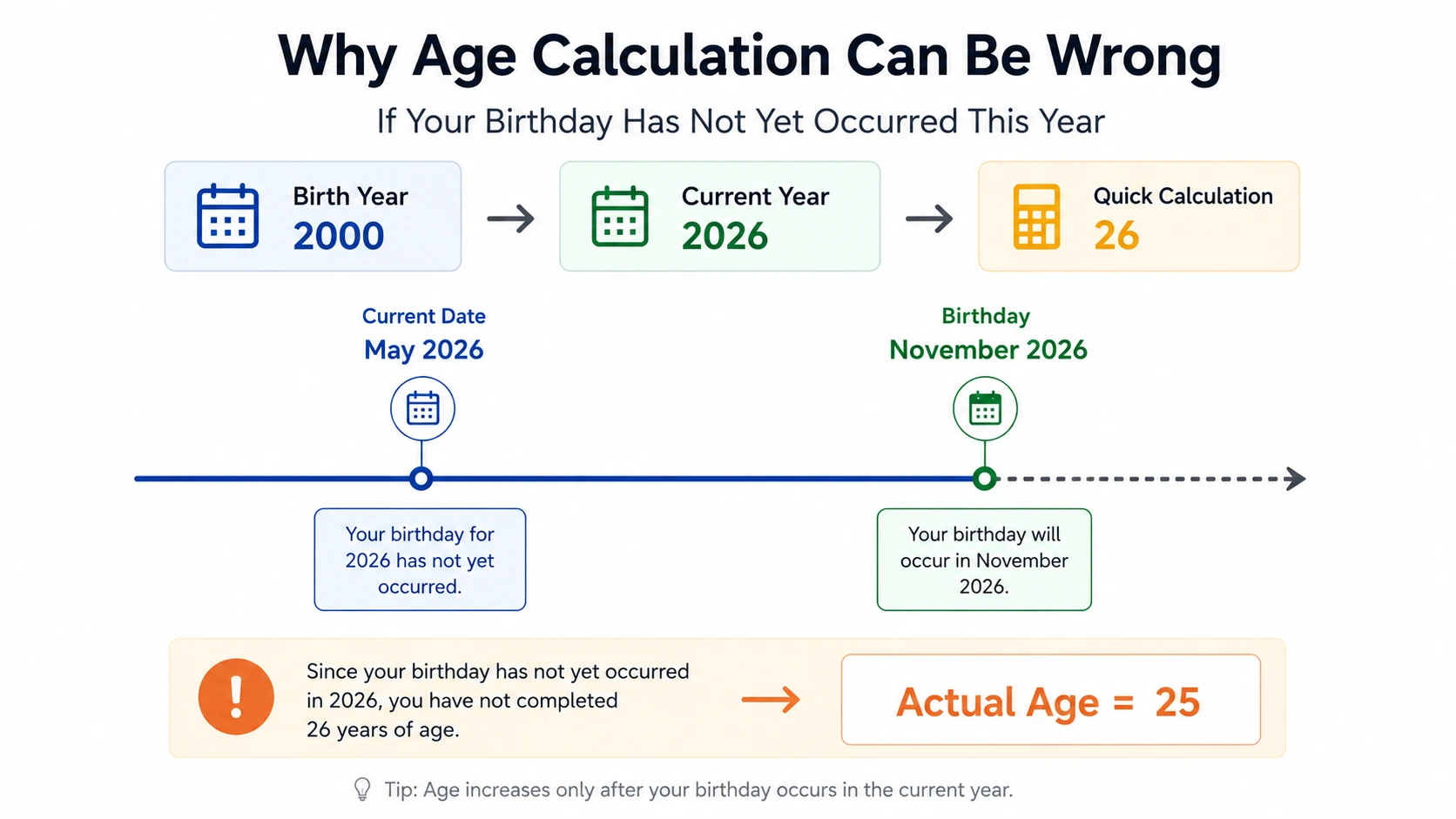
At first glance, the answer looks correct.
But suppose the person was born in November and today’s date is May 2026. Their birthday has not happened yet.
That means the actual age is still 25.
This type of incorrect age calculation regularly affects:
school eligibility
competitive exams
retirement checks
government applications
age-restricted programs
Real Example
A student applying for a scholarship believed they met the maximum age requirement because they calculated:
2025 − 2007 = 18
However, the scholarship deadline was in February, and the student’s birthday was in August. Officially, the applicant was still 17 at the time of verification.
The application category had to be changed after document review.
Schools rely on exact cutoff-date logic rather than year-based estimation, which changes eligibility outcomes even within the same birth year.
Incorrect Borrowing During Date Subtraction
One of the biggest sources of age calculation errors happens during manual subtraction of dates.
If you want to understand the full process more accurately, this guide on how to calculate age manually step by step explains how borrowing, month adjustments, and date subtraction work in real calendar calculations.
Most people understand normal subtraction, but calendar subtraction behaves differently because:
months contain different numbers of days
Dates require adjustments.
Borrowing depends on calendar structure.
This confusion usually appears when:
The current day is smaller than the birthday.
the current month is smaller than the birth month
You cannot directly calculate:
11 − 24
So people borrow days from the previous month.
The problem is that many people borrow incorrectly because they assume all months behave the same way.
This creates:
wrong month adjustments
incorrect day totals
inaccurate final ages
I have even seen paper-based office records where employees manually corrected dates differently because each person used a different borrowing method.
That inconsistency is one reason many organizations still rely on structured verification systems rather than informal calculations.
Assuming Every Month Has the Same Number of Days
Many people unconsciously treat months as equal units, even though the calendar does not work that way.
Different months contain:
28 days
29 days
30 days
31 days
This becomes especially confusing near month endings.
Example
Suppose someone tries to calculate the duration between:
January 31
February 28
Some people assume this equals:
“1 full month”
Others count exact days.
The result changes depending on the interpretation method being used.
This is one reason common mistakes while calculating age happen even in office environments. The complexity largely comes from the structure of the Gregorian calendar system explanation, where months contain different numbers of days and follow specific calendar rules.
Why This Matters
Month-length confusion can affect:
age-sensitive applications
contract durations
retirement calculations
eligibility timelines
official documentation reviews
It also creates problems when people manually compare dates without understanding the actual month structure inside the Gregorian calendar.
Leap Year Misunderstandings
Leap years create another layer of confusion in date-based calculations.
Most people know leap years happen every four years, but many do not realize there are exceptions and special cases.
The most common issue involves:
February 29
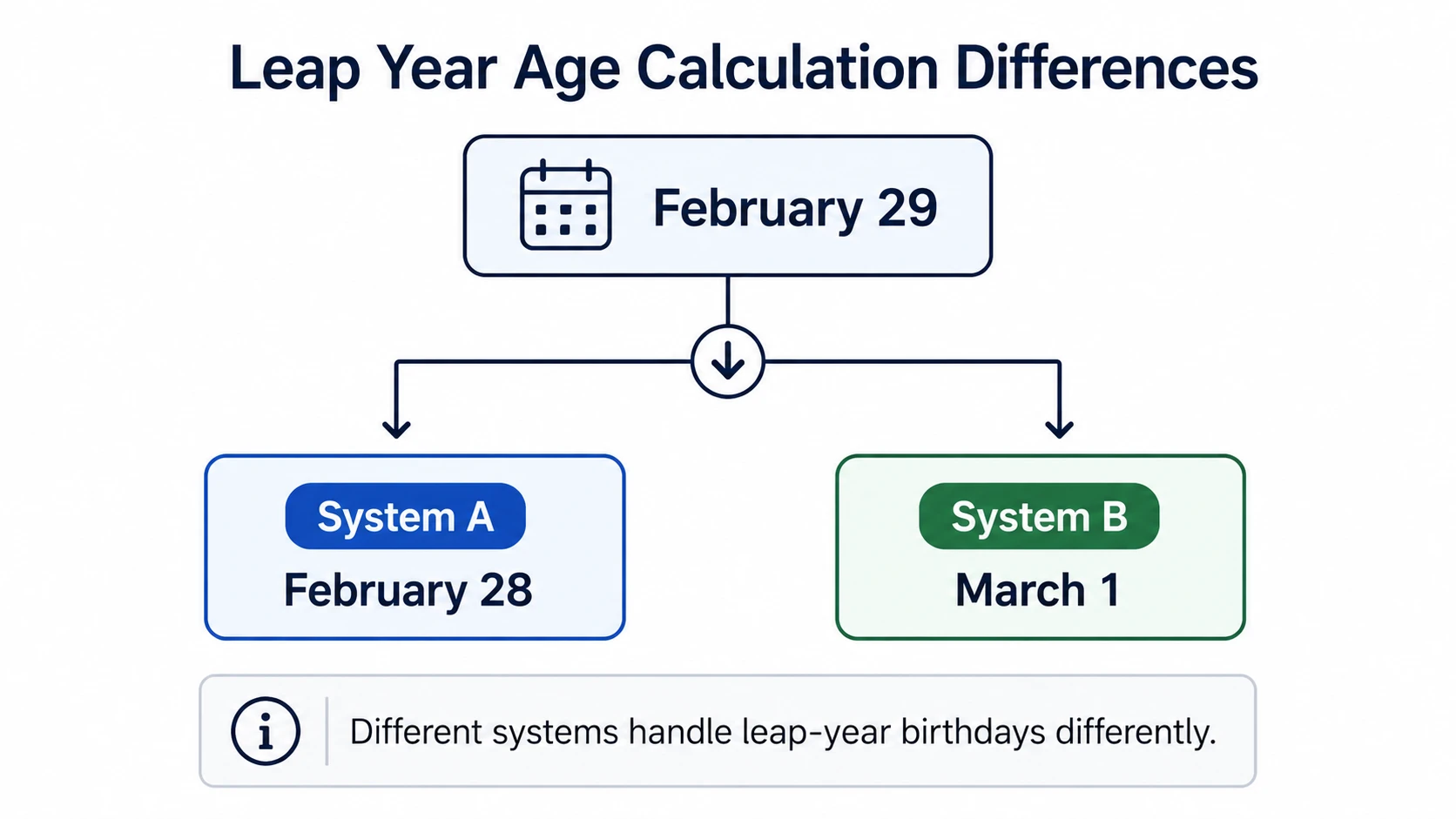
A person born on a February 29 date may experience:
inconsistent birthday handling
database mismatches
verification confusion
legal interpretation differences
This becomes especially noticeable during:
international applications
government systems
medical records
older databases
Real Situation
During testing of multiple online date systems, I noticed that February 29 birthdays were not handled consistently across platforms.
One system automatically adjusted the date to February 28, while another shifted it to March 1.
This difference directly affected the calculated age output when the same user data was tested in different systems.
👉 This shows that the issue is not the birth date itself, but how different systems interpret leap year handling rules.
This is one reason leap year age calculation errors continue to appear even in digital systems.
Another Common Misunderstanding
Some people incorrectly assume:
“Every fourth year is automatically a leap year.”
But centennial years behave differently under official calendar rules.
Most people never notice this because the effect is rare, but it still matters in long-term date verification systems and historical records.
Time Zone & International Date Mistakes
This is one of the least-discussed areas in online age verification.
Most people assume a birth date is identical worldwide, but international systems sometimes process dates differently depending on:
country
server time
UTC
local time zone
midnight transitions
Real Example
Imagine a baby born at:
11:55 PM in one country
At that exact moment, another country may already be in the next calendar day.
This can create:
date inconsistencies
immigration record confusion
international identity mismatches
I once compared two online systems during testing where the same timestamp generated slightly different DOB records because one platform converted the time automatically while the other stored the local date exactly as entered.
These situations are uncommon, but they become important in:
international legal systems
immigration document verification
visa applications
cross-border databases
Most calculator websites never discuss this issue, which is why this remains a highly misunderstood area of date verification.
Mistakes in School, HR & Government Verification
In real-world administration, small date mistakes can have major consequences.
This is why schools, HR departments, and government offices often verify dates manually instead of relying only on automated calculations.
School Admission Example
Many schools use strict school admission cutoff policies.
Suppose admission rules require:
"A child must complete 5 years before April 1.”
A child born only a few days after the cutoff may become temporarily ineligible, even though the difference appears small.
A common assumption is that birth year alone determines eligibility, but institutions strictly evaluate exact dates.
HR Verification Example
In hiring processes, companies sometimes verify:
minimum employment age
retirement eligibility
training requirements
age-restricted positions
An HR team may reject incomplete or mismatched DOB records because:
Incorrect records affect compliance.
Payroll systems depend on accurate dates.
benefits may rely on verified age data
HR systems cross-check DOB across multiple records to ensure compliance with payroll, benefits, and legal age requirements.
Government & Passport Verification
Government systems are especially strict because age affects:
identity validation
retirement benefits
pension calculations
visa applications
official documentation
Even a small date mismatch can delay processing.
Government systems often require manual validation when discrepancies appear between submitted documents and official records.
Why Manual Age Verification Still Matters
Digital tools are useful, but manual verification still plays an important role in many environments.
Why?
Because humans can identify:
formatting inconsistencies
unusual date patterns
impossible timelines
document conflicts
suspicious discrepancies
Automated systems process data quickly, but they may not always understand context.
For example:
a missing zero
reversed month/day entry
impossible age combination
may still require human review.
In one observed verification case, an automated system initially accepted an incorrect DOB entry before a later manual review identified that the month and day had been reversed during submission.
Without secondary verification, the discrepancy would likely have remained undetected.
This is why understanding basic calendar logic still matters, even when digital tools are available.
This kind of issue is one reason manual verification still exists even in fully automated systems, as human review helps catch structural errors that software may not flag.
A Simple Framework to Avoid Age Calculation Errors
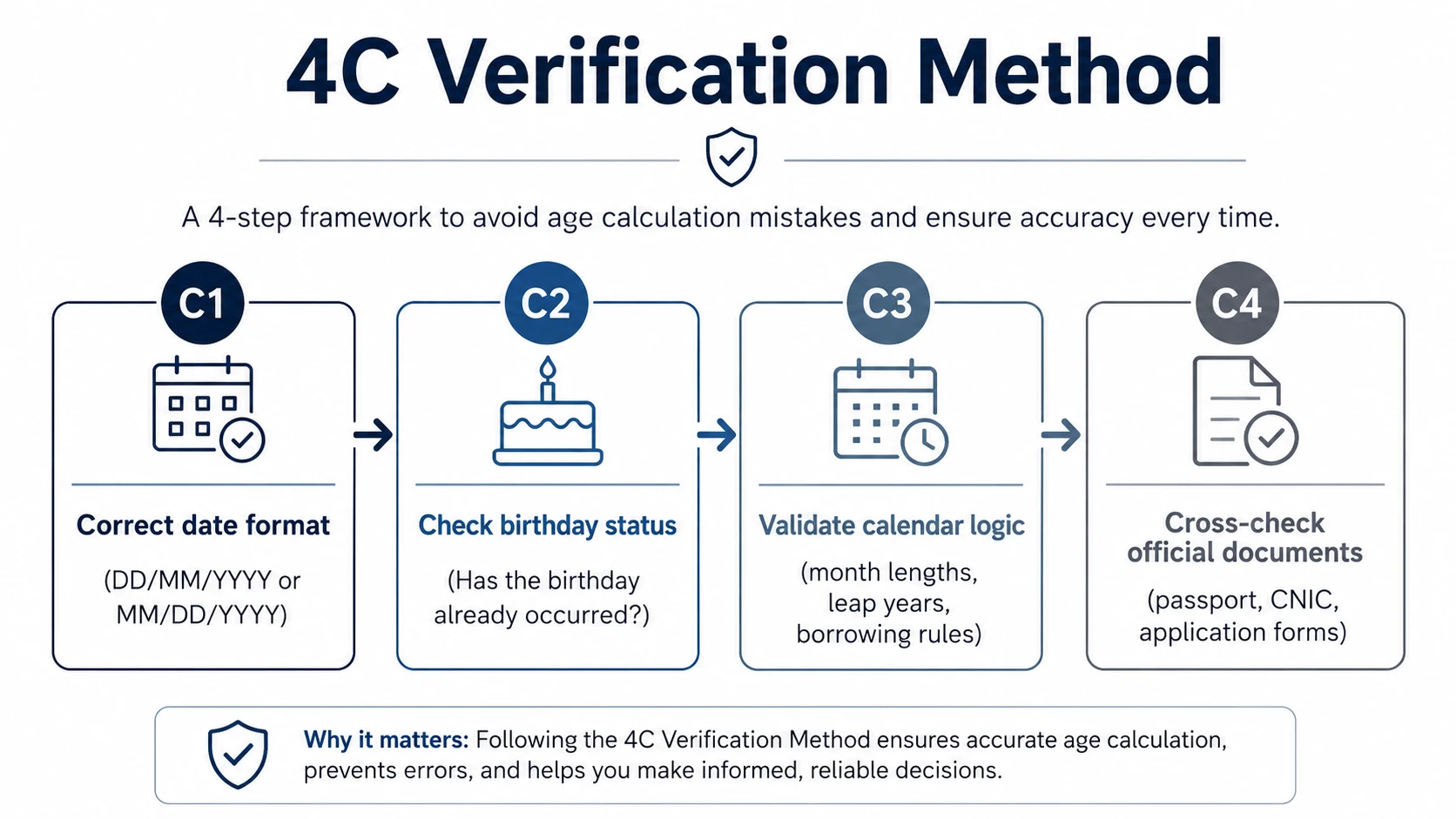
After reviewing multiple real-world cases, this 4C Verification Method consistently helps reduce age calculation mistakes and improves accuracy in official forms.
Cross-check official documents (passport, CNIC, and application forms).
This framework is especially useful for parents, HR staff, students, office administrators, and immigration-related applications where even small date inconsistencies can lead to verification issues or delays.
The key advantage of this method is consistency — it reduces human error by forcing a structured check instead of relying on quick mental calculation.
How to Avoid Age Calculation Errors
If you regularly work with dates, forms, or eligibility checks, a few simple habits can reduce mistakes significantly.
Best Practices
Verify the date format first
Always confirm whether the system uses:
DD/MM/YYYY
ORMM/DD/YYYY
1. Check whether the birthday already occurred.
Never rely only on birth year subtraction.
2. Review month lengths carefully.
Do not assume all months behave equally.
3. Watch for leap-year situations.
Especially when dealing with:
February dates
long-term records
historical timelines
4. Double-check official forms before submission.
Many errors happen because users submit forms too quickly without reviewing confirmation screens.
For better accuracy during verification, reviewing an online age calculator guide and usage can also help users understand how digital tools process birthdays, leap years, and date formats.
5. Cross-check documents
If multiple documents show different DOB formats, verify which version is officially accepted.
These habits help reduce:
age verification mistakes
processing delays
document inconsistencies
administrative confusion
When an Online Age Calculator Becomes More Reliable
Manual understanding is useful, but repeated data verification can still become confusing over time.
This is where a properly designed online tool becomes more reliable for:
repeated calculations
official use cases
consistent date handling
reducing human calculation error
Instead of relying on rough subtraction or memory-based estimation, a structured tool can help standardize calculations across different situations.
If you want to double-check calculations or avoid manual mistakes, you can use the e4Tools Age Calculator for more consistent verification.
FAQs
People often calculate age incorrectly because they ignore month and day adjustments, use wrong date formats, or fail to check whether the birthday has already occurred in the current year. These small issues are part of common age calculation mistakes that lead to incorrect final results.
Your calculated age may be wrong due to an incorrect date of birth entry, a reversed day/month format, leap year handling, or ignoring whether the birthday has already passed in the current year. Even a small input error can change the final age by one year.
Age differs by one year when the birthday has not yet occurred in the current year. Simple year subtraction ignores the exact birth date, which causes this common one-year difference in results.
Different calculators show different age results due to variations in date format interpretation, leap year rules, time zone handling, and calculation methods. These differences can lead to slightly different age outputs for the same date of birth.
Yes, date formats can change age results. For example, 03/07/2001 may be interpreted as 3 July or 7 March depending on regional settings, leading to different age calculations in different systems.
Leap years affect age calculation because February 29 occurs only every four years. Systems handle this date differently by shifting it to February 28 or March 1, which can slightly impact age calculations.
Schools verify exact age because admission rules depend on specific cutoff dates, not just birth year. Even a difference of a few days can affect eligibility, so precise age verification is required.
Conclusion
Many age-related mistakes happen because people assume calendar calculations are simpler than they really are. In reality, small differences involving formats, birthdays, leap years, or month lengths can completely change verification outcomes.
These issues become especially important in:
school admissions
employment verification
government records
immigration systems
retirement eligibility
Understanding the most common age calculation mistakes helps reduce incorrect submissions, avoid unnecessary delays, and improve overall date accuracy in real-world situations.
And while manual understanding remains valuable, using a reliable tool for final verification can help reduce human error and improve consistency in official calculations.
For quick and more reliable verification, you can also use the e4Tools Age Calculator.
Try a faster and more accurate method below: