Can You Get in Trouble for Paraphrasing? Legal Risks, Plagiarism & AI Rules (2026)
Apr 27, 2026
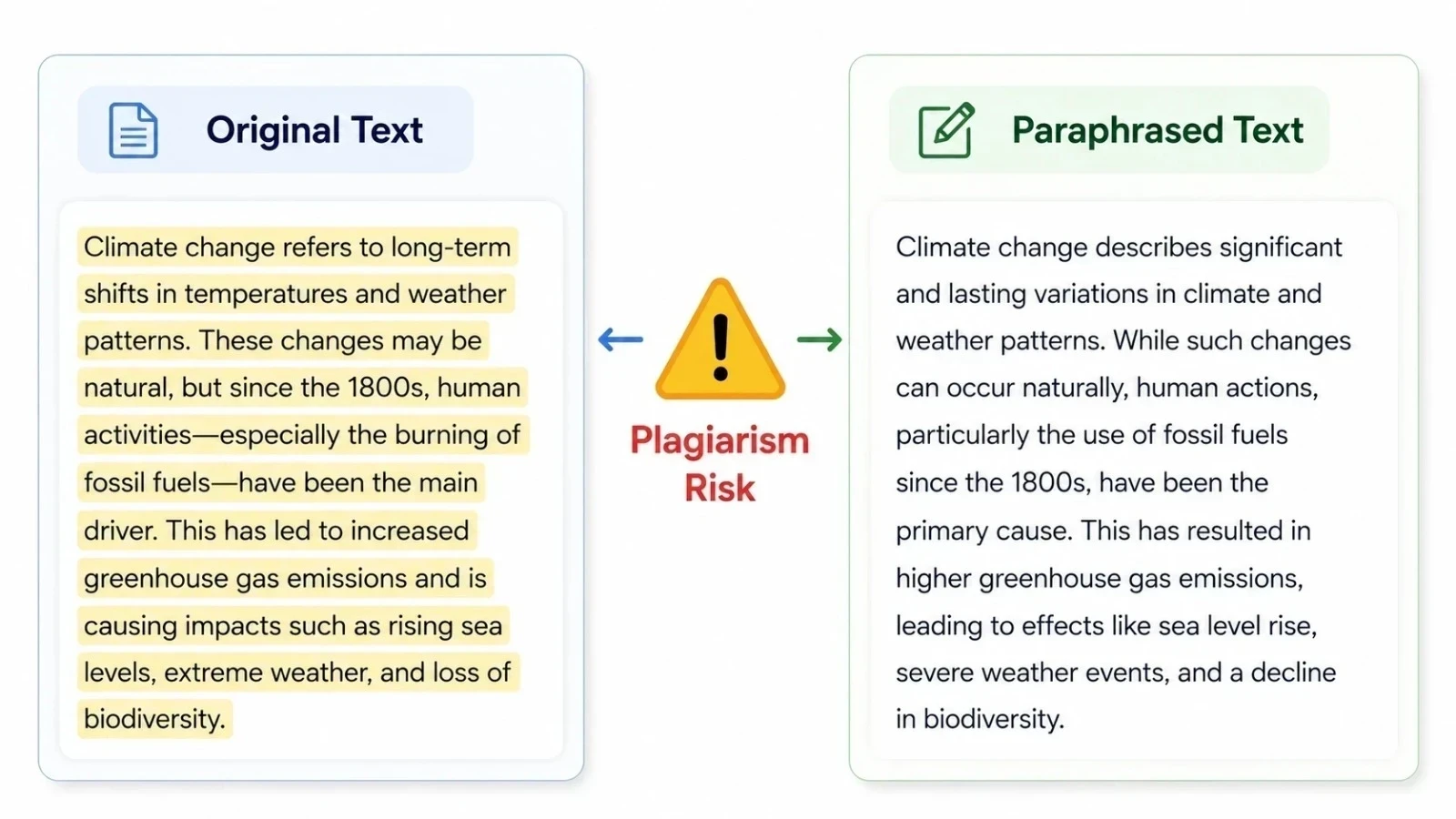
Yes, you can get in trouble for paraphrasing if it is too similar to the original text, lacks citation, or is misused in academic or professional writing.
Almost all students, bloggers, and content writers do the paraphrasing at some point. However, the question that comes in the minds of many people is this: can you get in trouble for paraphrasing?
The simple response to this is yes, you can get in trouble when paraphrasing, but under certain conditions. It is not that you are committing any crime when you paraphrase; however, how you paraphrase them sometimes leads to consequences that are big, like plagiarism, copyright and academic sanctions. This is where most confusion starts.
Simply put, paraphrasing is the process of rewriting the ideas of someone in your language without altering their original sense. Just changing some words is not enough. Where the structure or conception is too related to the original work, then it can be regarded as plagiarism.
This subject has become even more significant in 2026 due to AI tools. Nowadays, AI is used by many people to rewrite the content, although not everything that is included in it is safe or legal. Originality and the quality of content are also being prioritized heavily by platforms such as Google, so improperly paraphrased or copied content can influence rankings or trustworthiness.
If you're new to AI rewriting, you can first understand how it works in this complete guide on using a free AI paraphrasing tool effectively without plagiarism.
In this blog we are going to deconstruct all of that in simple terms, such as whether paraphrasing is legal, when it is risky, how AI influences paraphrasing, and how you can safely paraphrase without getting into trouble.
IS PARAPHRASING LEGAL?
As a rule, paraphrasing is legal, yet it all comes down to how you use it. When you borrow an idea and completely paraphrase it in your own words without altering the meaning, it is generally perceived to be all right. The question of legality, however, arises whenever paraphrasing becomes too similar to the original or not given proper attribution.
Paraphrasing is permitted in most educational and professional settings as long as you are not copying the sentence structure or presenting the work of a particular person as your own. Here the idea of source attribution comes in. Even when you rewrite it, in most instances you still are required to state the source of the idea.
When it comes to copyright law, it typically does not protect ideas themselves but does protect the expression of them. It refers to the fact that you are not allowed to replicate the way something is written, but you can describe the same thing differently. This is why paraphrasing sits in a “safe zone” only when done properly.
This concept is also supported by official copyright guidelines. According to the U.S. Copyright Office, copyright protects the expression of ideas rather than the ideas themselves.
So, paraphrasing is legal when:
You genuinely rewrite the content in your own structure
You do not copy sentence patterns
You do not misrepresent the original source
You give credit when required
In short, paraphrasing is legal if it is ethically and cautiously done to avoid plagiarism and copyright.
WHEN DOES PARAPHRASING BECOME ILLEGAL?
Paraphrasing can be dangerous or even problematic when it oversteps some boundaries. The most common issue is copyright infringement, which arises when the rephrased information is too similar to the original work. Although words may be altered, identical structure or flow would still be a violation of intellectual property rights in the same way.
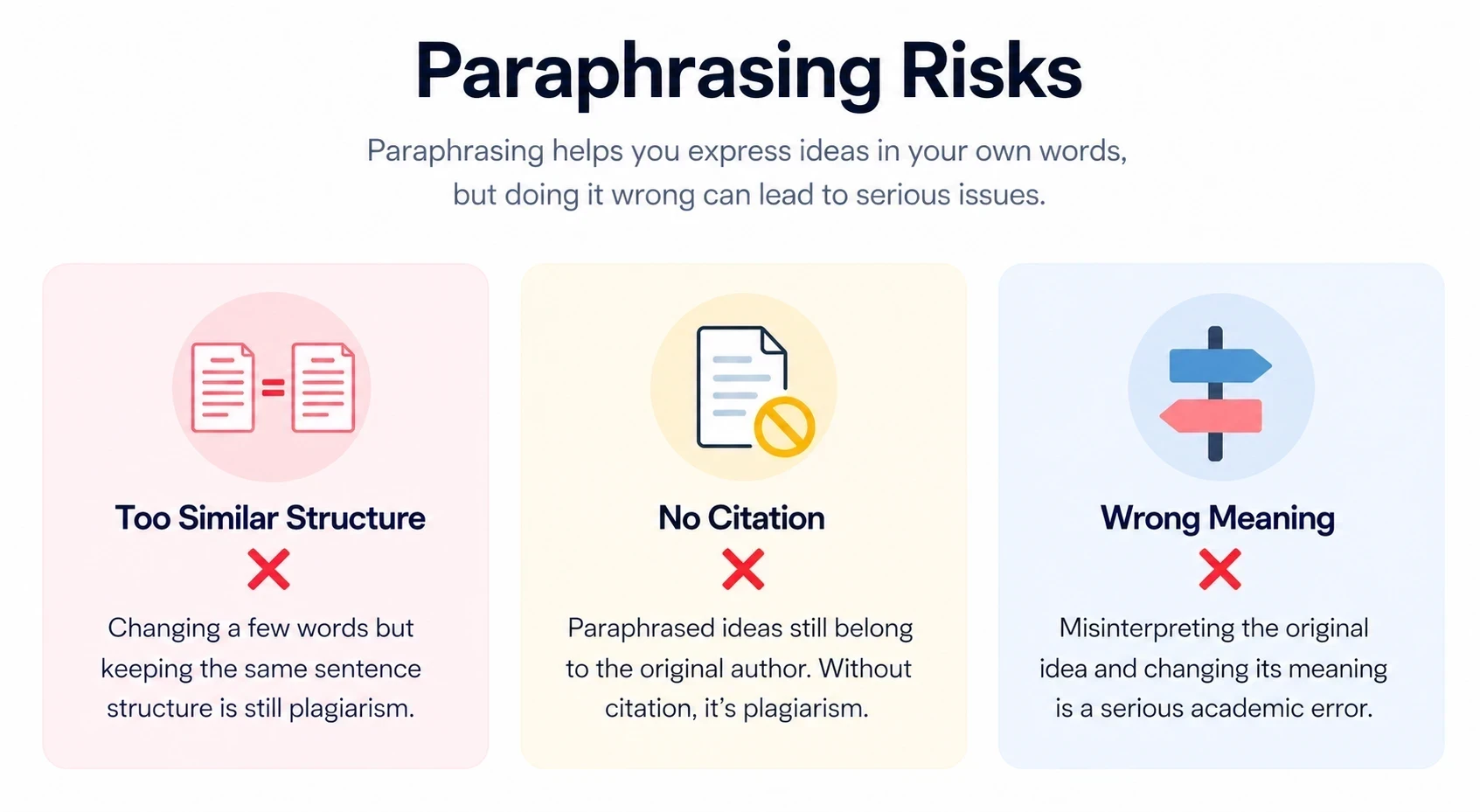
Paraphrasing can be dangerous or even problematic when it oversteps some boundaries. The most common issue is copyright infringement, which arises when the rephrased information is too similar to the original work. Although words may be altered, identical structure or flow would still be a violation of intellectual property rights in the same way.
Lack of attribution is another big problem. When you rephrase the ideas of someone and fail to provide a reference source where necessary, it may be considered dishonest or even plagiarism in an academic or professional context. This is especially strict in universities and publishing industries.
A third situation is misrepresentation of ideas. Sometimes people paraphrase but accidentally change the meaning of the original content. It could result in misinformation that is also considered unethical in writing.
To make it simple:
Too similar structure = risky
No credit given = plagiarism risk
Wrong meaning = ethical issue
These are the key reasons why paraphrasing is not always safe and sometimes it is dangerous. This is also one of the reasons why understanding the original content and then rewriting it in an appropriate way is so important.
Paraphrasing is not merely a matter of word substitution – it is a matter of responsible rewriting without copy-pasting expressions and distorting facts.
CAN PARAPHRASING BE CONSIDERED PLAGIARISM?
Yes, it can be classified under plagiarism when it is not done properly. This is among the greatest misconceptions in writing. Many people believe that they can simply change several words and make the material original, however, this is not true.
Plagiarism is not only about copying text word-by-word. It also includes copying ideas, structure, or flow without proper transformation or credit. It is still plagiarism in instances where your paraphrases resemble the original source too closely.
For example, if you take a paragraph and only replace a few words with synonyms while keeping the sentence structure the same, it is still considered plagiarism in many cases. Proper paraphrasing requires rethinking the sentence entirely and presenting it in a new form.
Many writers fail at this step, which leads to serious issues — here are the most common paraphrasing mistakes and how to fix them with real examples.
That is the reason why academic institutions and content platforms are so concerned with originality. As a matter of fact, even search engines such as Google are giving more priority to unique content since that matters to the users.
To avoid plagiarism in the process of paraphrasing, you need to:
Understand the full idea before rewriting
Change sentence structure completely
Use your own writing style
Add citation when necessary
If you want a deeper breakdown with real examples, you can read this detailed guide on how to avoid plagiarism in content writing.
So yes, paraphrasing can become plagiarism — but only when it is done incorrectly or carelessly.
LEGAL RISKS OF PARAPHRASING (REAL CONSEQUENCES)
Although paraphrasing is common, it has still got some actual consequences in case it is not done right. The consequences can vary depending on whether you are a student, a blogger or a professional writer.
In educational institutions, the impacts of plagiarism can be devastating in terms of losing marks or assignments or even being disciplined. Universities do not tolerate plagiarism, and one of the most frequent mistakes students make is paraphrasing without understanding it.
In the case of bloggers and owners of websites, the risk is a bit different. It is possible that even search engines like Google do not punish paraphrasing, and yet the poor quality or copied material may lead to low ranks. In the absence of original content, your content will not rank high in search results.
The other problem is a copyright claim in case you are paraphrasing other print articles, books, or professional work that you do not have permission for. These may result in legal notices or takedown requests in certain situations.
Finally, there is the possibility of ruined reputation in the long run. The association with plagiarized or poorly paraphrased text can have an impact on trust and credibility, whether you are a student, writer or an owner of a business.
QUICK COMPARISON: RISKS OF PARAPHRASING
This shows that paraphrasing risk is not random — it depends on how much transformation and care is applied during rewriting.
REAL-WORLD EXAMPLES OF PARAPHRASING MISTAKES
In my experience working with SEO content, in most cases, paraphrasing problems arise when authors completely trust AI tools without reformulation of sentences.
To understand how paraphrasing problems actually happen, here are a few real-life style situations:
Example 1: Student Case
A student used paraphrasing by only replacing words with synonyms from a tool. The sentence structure stayed almost the same, and the assignment was flagged for similarity. This resulted in a reduced grade because the teacher considered it weak paraphrasing.
Example 2: Blogger Case
A beginner blogger rewrote articles using AI without editing structure. Even though the text looked different, Google detected similarity in content pattern, and the page did not rank well due to low originality signals.
Example 3: AI Paraphrasing Issue
A writer used AI to paraphrase legal content, but the output slightly changed the meaning. This caused confusion and required manual correction before publishing.
KEY INSIGHT
The failure of most content does not occur due to paraphrasing itself but rather the fact that writers put AI production as a final copy rather than a draft.
IS AI PARAPHRASING LEGAL IN 2026?
AI paraphrasing tools have become extremely popular, but their legal and ethical use depends on how they are used. The process of AI-generated rewriting is not considered illegal in most cases in 2026, yet the user is still liable.
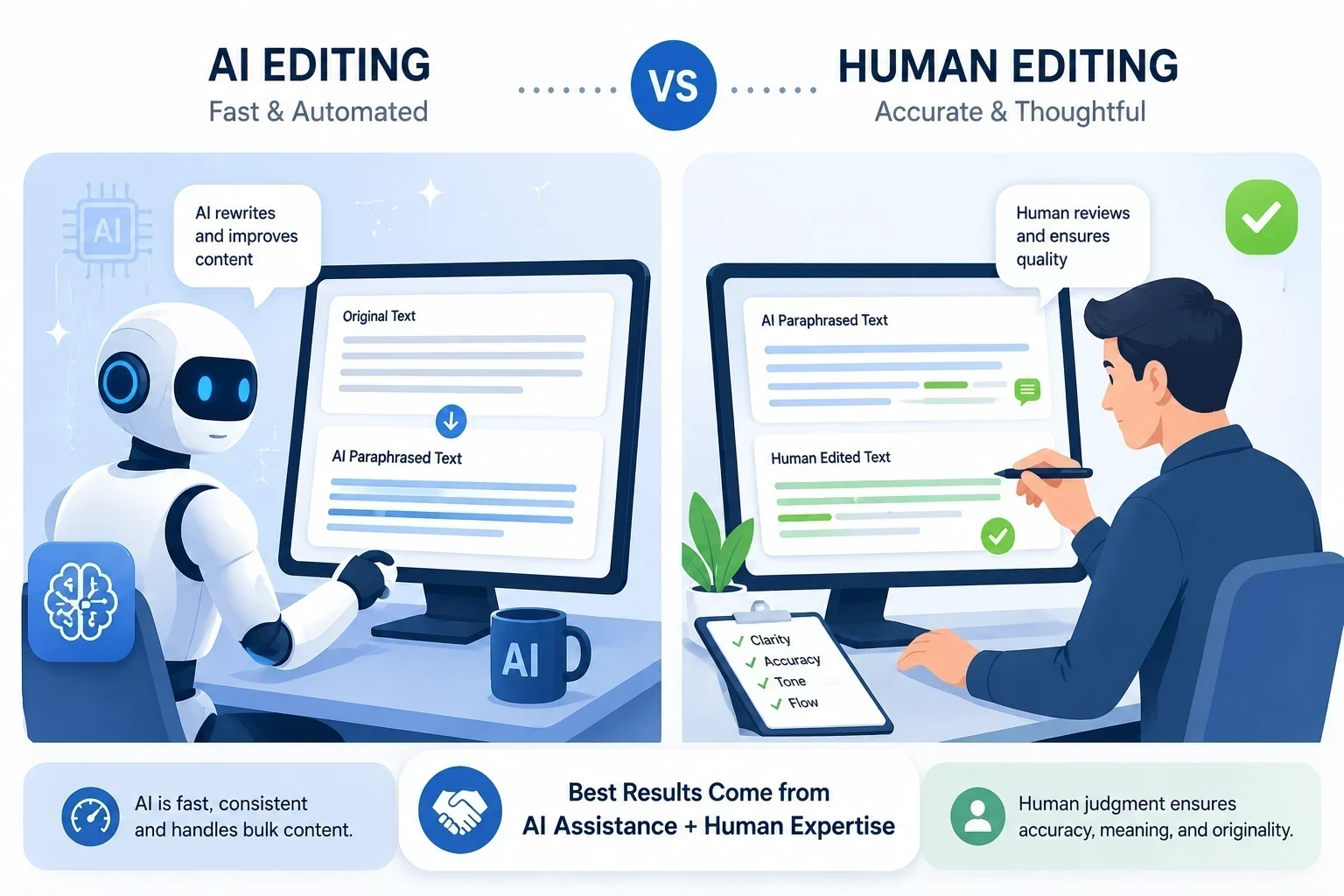
The AI tools can be used to paraphrase text very fast, although they do not necessarily ensure originality. In other cases, the AI can generate content that is excessively similar to the previous source, and this can lead to the problem of plagiarism unless it is checked out accordingly.
Google gives much attention to valuable and original material as well. This implies that it is not just a matter of exercising AI, but human editing is also needed to guarantee quality and accuracy.
As highlighted in Google Search Central guidelines, content should be helpful, original, and created for users — not just rewritten for rankings.
AI paraphrasing becomes risky when:
It is used without checking originality
It copies structure from existing sources
It is published without human review
However, AI can become an effective writing tool in case it is applied properly and with the aim of enhancing efficiency, brainstorming and rephrasing content safely.
REAL CASE STUDY: HOW PARAPHRASING GOES WRONG IN 2026
An AI tool was used to paraphrase various blog posts on a single website by a content writer. At first, the content looked completely new. However, the articles failed to perform well on Google after publishing.
In another case, a student relied completely on AI paraphrasing for an assignment. Although the wording looked different, the teacher identified similarity in meaning structure and flagged it for review.
This indicates that paraphrasing does not merely involve the transformation of words, but it involves human comprehension and reorganization.
HOW TO PARAPHRASE SAFELY (WITHOUT GETTING IN TROUBLE)
Safe paraphrasing is all about technique, in case you want to play it safe and avoid all legal or plagiarism issues. The initial one is to have a clear grasp of the original content. You cannot rewrite something properly if you do not understand it clearly.
Next, instead of changing individual words, focus on changing the entire structure. This includes sentence order, flow, and expression style. Simply replacing words is not enough.
You should also avoid relying completely on tools. Although you may be using AI or paraphrasing software, always go through and read the results and amend them. This helps ensure originality and accuracy.
Another important step is citation. It is safe to give credit when you are using the ideas of another person. Safe paraphrasing also means preserving meaning. You must not twist or misinterpret the original message.
Finally, you can also take advantage of tools such as our AI paraphrasing tool to accelerate the process, though it is still necessary to humanly edit your work to make sure it is safe and of quality.
R.E.W.R.I.T.E Framework (Safe Paraphrasing Method 2026)
To paraphrase safely and avoid plagiarism risks, use this simple framework:
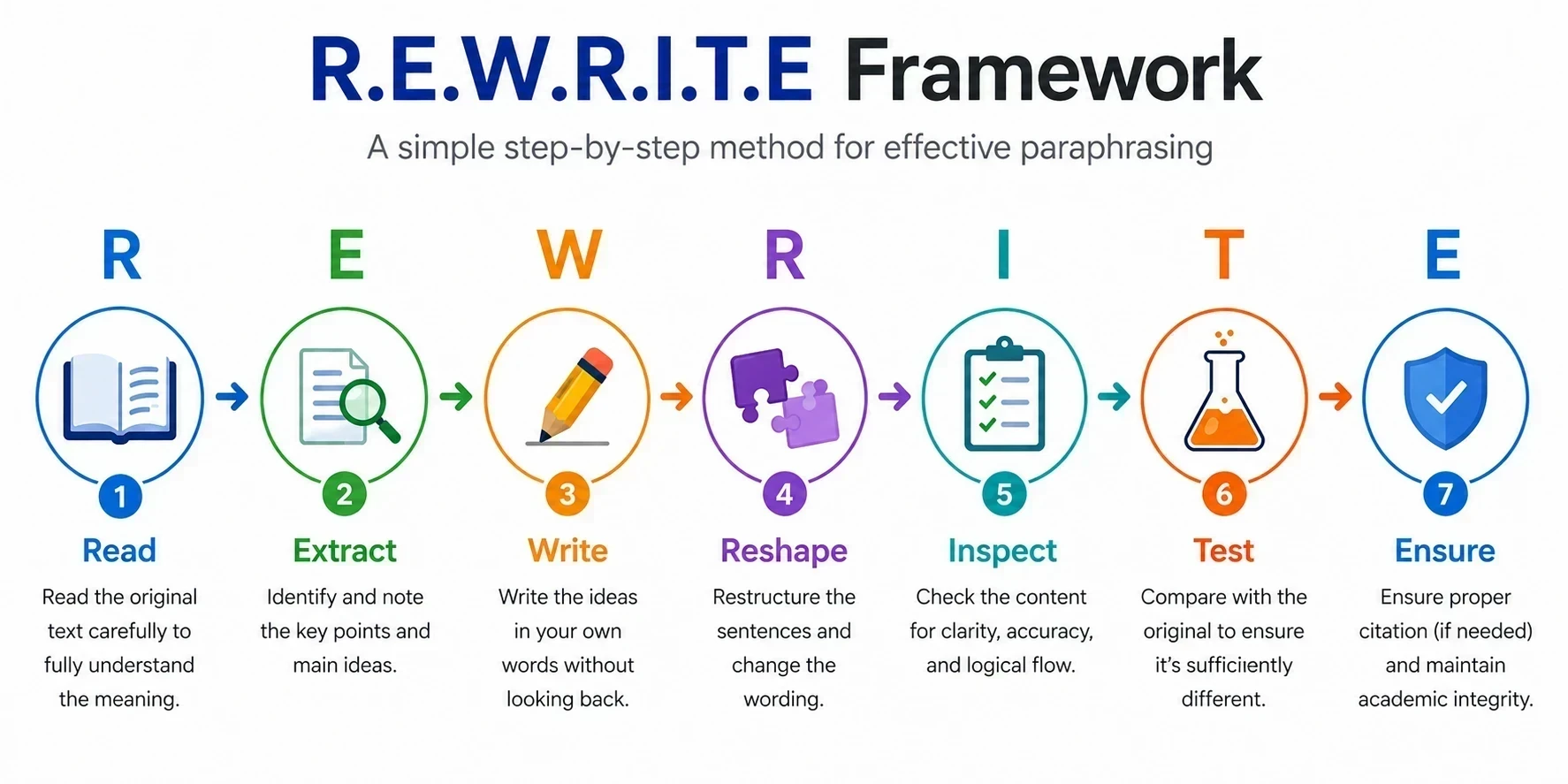
R → Read the original idea carefully
E → Extract the main meaning
W → Write in your own sentence structure
R → Reshape flow and wording completely
I → Inspect similarity before publishing
T → Test readability and clarity
E → Ensure proper citation if needed
This method helps writers:
Avoid accidental plagiarism
Improve originality score
Maintain clear meaning
Strengthen writing quality for SEO and academic use
R.P.D.M DECISION MODEL (BEFORE YOU START PARAPHRASING)
Before paraphrasing any content, check these 3 levels:
1. Structure Level
Did I change sentence structure completely?
2. Meaning Level
Did I preserve the original intent without distortion?
3. Source Level
Do I need to cite the original idea?
If any one level fails → paraphrasing is unsafe.
PARAPHRASING RULES: STUDENTS VS BLOGGERS VS PROFESSIONALS
Paraphrasing expectations can differ according to the context. Paraphrasing rules are not the same for everyone.
Students are required to adhere to academic guidelines, such as appropriate referencing, originality, and preventing plagiarism. Even minor errors during paraphrasing may result in grade penalties or disciplinary measures.
The bloggers are more concerned with the SEO, uniqueness of the content and the value for the readers. Inappropriate paraphrasing itself might not be seen as a cause of legal issues; however, it might negatively affect the search results and decrease the visibility of the content.
Professionals, especially in legal, business, or publishing fields, require a high level of accuracy. Even minor misinterpretation can lead to legal risks, copyright issues, or damage to credibility.
Key Difference:
Students risk academic penalties
Bloggers risk SEO performance
Professionals risk legal and reputational consequences
COMMON PARAPHRASING MISTAKES
Many people unknowingly make mistakes while paraphrasing. One of the most common mistakes is only changing a few words instead of rewriting the structure. Another is not giving proper credit when needed.
Overusing AI tools without editing is also a growing problem. Some people also copy the original structure too closely, which reduces originality.
CHECKLIST: ARE YOU PARAPHRASING SAFELY?
Before publishing any rewritten content, ask yourself:
Did I fully rewrite the structure?
Did I preserve the original meaning?
Did I avoid copying sentence patterns?
Did I review AI-generated text?
Did I add citations where needed?
If the answer is yes to all, your paraphrasing is generally safe.
The following are the frequent questions regarding paraphrasing and legal risks in 2026:
FAQs
Yes — but only when paraphrasing is done incorrectly. A threat occurs when the rewritten information is excessively similar to the original source, lacks proper citation, or changes the intended meaning. This may also result in plagiarism warnings or copyright issues in academic and professional writing. The important point is not whether paraphrasing is copied but to which extent it is similar to the original structure and wording.
Paraphrasing sits in a legal “safe zone” when done properly. It becomes plagiarism only when originality is missing or credit is not given.
The difference depends on transformation. If you fully rewrite the idea in your own structure, it is legal. If you only swap words or copy sentence flow, it may be treated as plagiarism.
Paraphrasing generated by AI can occasionally be identified since it might resemble the patterns of the existing content.
Although AI tools can speed up the process of rewriting, they do not ensure originality. Unless the output is checked or revised, it can still cause plagiarism or less content credibility in search engines such as Google.
AI paraphrasing is only safe as an assistant but not as a final publishing option.
It should be used by the students as a means of learning and drafting, whereas final work must be original. Idea generation can be facilitated by AI among bloggers, yet the result of the job should be subjected to human editing to retain high-quality SEO and originality.
Paraphrasing in an educational context is not a crime, but it is possible to refer to it as plagiarism in cases that are carried out inappropriately. Schools do not overlook word changes but also structure. Plagiarism can be suspected even in cases when a rewritten text remains very similar in structure to the original, or when a citation is not provided. The students are expected to be capable of understanding the source and demonstrate the idea in their own writing style with proper crediting where necessary.
Safe paraphrasing follows a simple process:
Understand the original idea completely
Rewrite using a new sentence structure
Avoid copying tone or flow
Keep meaning accurate
Add citation when required
This ensures originality while maintaining correctness.
There is no fixed number of words to change. What matters is structural transformation.
The sentence may be flagged in case it remains similar after rewriting. Good paraphrasing varies the style of expression, not the words only.
Yes – particularly in academic, research, and business writing.
Even if the text is rewritten, the idea still belongs to the original source. Citation creates transparency and avoids plagiarism issues. It is optional, though the best practice is blogging.
They are not the same but related. Paraphrasing is focused on rewriting specific ideas, whereas rewriting takes a more structural change or rearranging content altogether.
They both should be original, but paraphrasing is more sentence-focused and precise. If you're still confused between techniques, this guide clearly explains the difference between paraphrasing vs summarizing.
Knowledge + rewriting + human check is the safest approach.
AI might assist; however, the ultimate output needs to be refined by humans. This guarantees originality, minimizes the risk of plagiarism, and guarantees retainability in terms of SEO and academic quality.
Conclusion
There is nothing to be afraid of in paraphrasing; you just need to learn how to do it right. Can you get in trouble for paraphrasing? Only when it is incorrectly done. It is completely legal when handled the right way, but it can lead to problems if approached carelessly.
It is all about focusing on comprehending, rewriting correctly and remaining original. Safe paraphrasing will put you out of worry over plagiarism and lawsuits whether you are a student, blogger or professional.
Finally, you can also use our AI paraphrasing tool to speed up rewriting, but always review and refine the output to ensure originality and accuracy.
Improve clarity, avoid plagiarism, and create original content in seconds.